So I was in Union Square doing a camera test with a new video camera. I bumped into a class shooting street photographs.
One of the students came over to ask if she could take my photograph, and talked about how tough it was for her to photograph people she didn't know.
We talked for a while, and I videotaped her a bit, and asked her a few questions. We talked for a moment about the ethics of street photography, and the experience of the process, and the sort of uncertain exchange that usually occurs.
I don't think she took my picture.
Tuesday, September 26, 2006

Saturday, September 23, 2006
12th and 3rd in Brooklyn
Won't you take me to... Monkeytown.
My documentary short "12th and 3rd in Brooklyn" is scheduled to screen there in a program called "Witness the Fitness" on Friday, September 29. Admission is $5 and showtimes are 7:30pm and 10pm. (Reservations are recommended.) Monkeytown is at 58 N. 3rd St, (between Kent & Wythe) in Williamsburg, Brooklyn.
The show intro says:
My documentary short "12th and 3rd in Brooklyn" is scheduled to screen there in a program called "Witness the Fitness" on Friday, September 29. Admission is $5 and showtimes are 7:30pm and 10pm. (Reservations are recommended.) Monkeytown is at 58 N. 3rd St, (between Kent & Wythe) in Williamsburg, Brooklyn.
The show intro says:
"It's Sports Vs. Art in the ultimate showdown for cultural supremacy! Be there LIVE to see artists wrestle with their athletic inadequacy, battle their alienation, and GO FOR THE GOLD, facing off against seasoned veterans from the spectrum of professional sports."(Note that "12th and 3rd in Brooklyn" is co-directed by Iris Lee and Maya Mumma.)
Tuesday, September 19, 2006
What Would Fred Wiseman Do?
I've been away from the blogging for one week finishing the Documentary short I mentioned previously. It's done. Might change a little -- post-critiques -- but it's essentially done. It took some work, though.
Two days shooting plus eight days editing equals a six-minute piece.
One highlight from that period: I saw Fred Wiseman speak and show clips from some of his movies in a session at Lincoln Center. Incredible presentation, really, as he skipped all the expected niceties and just spent time analyzing his own work. I learned more about approaching documentary structure while listening to him than from the last 10 books I've read....
Two days shooting plus eight days editing equals a six-minute piece.
One highlight from that period: I saw Fred Wiseman speak and show clips from some of his movies in a session at Lincoln Center. Incredible presentation, really, as he skipped all the expected niceties and just spent time analyzing his own work. I learned more about approaching documentary structure while listening to him than from the last 10 books I've read....
Monday, September 11, 2006
As True as it Needs to Be
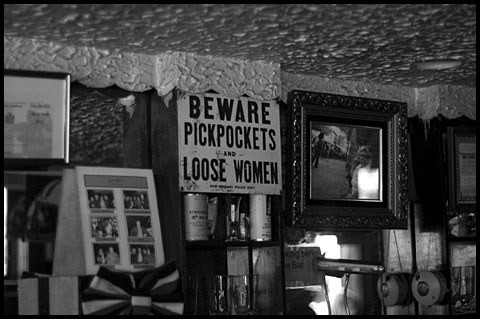
Any story depends on telling, and more so than we'd like to think.
The documentary project I'm working on -- loosely connected to stickball -- proceeds well enough. I've copied over about 1,600 stills, and about 5 hours of video. Now it just needs a beginning, a middle, and also an end.
Above: Brooklyn, September 10, 2006.
Sunday, September 10, 2006
On the Streets of Brooklyn
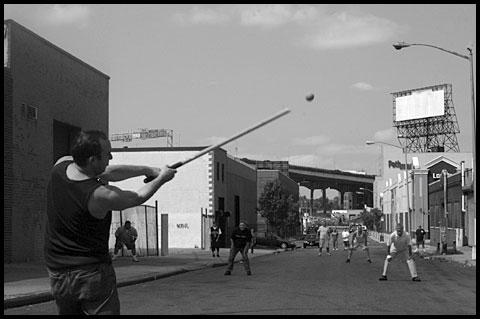
As far as I know, it was Elliott Erwitt who said, "If you don't go, there are no pictures."
And as far as I know, it was Weegee who said, "F8 and be there."
Above, Stickball, 12th Street, Between 2nd and 3rd Avenues, Brooklyn.
Saturday, September 09, 2006
The Sporting Life
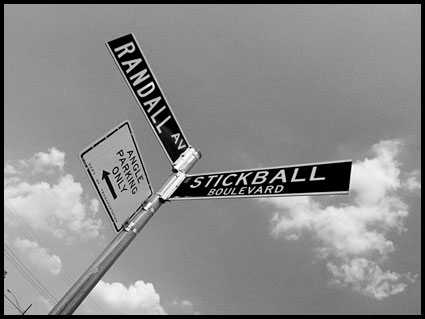
I'm working on a very short documentary about New York. Stickball is a part of it, but also I'm hoping it will connect to some other ideas on youth and fun -- and my dislike of the regimented, the rank-and-file and the serious.
I'll let you know how it goes....
Thursday, September 07, 2006
Wednesday, September 06, 2006
The Worst Students Make the Best Teachers
Starting September 15th I'm teaching Seriously Fun Photography at Hunter College Continuing Education. If enough people sign up, that is. So sign up. It's meant to be an easy-going way for people to move into advanced photography -- low pressure, but a high level of photo skills development. The listing in the catalog reads:
Build on the basics and master the skills and ideas advanced photographers use in a fun, low-pressure class. Open to anyone able to shoot a photo and import it into a computer (and welcoming advanced students as well), in this class we'll use the digital camera as a fast way to learn the essentials of photography. We'll learn-by-doing, exploring professional techniques while creating a portfolio project (on any topic of your choice) to show your advanced skills. If you've always been interested in photography, but have put off becoming great at it, this is your chance. Tuition: $225.00
Instructor: Ted Fisher
FRI 5:30:PM - 7:30:PM Location: TH 4th Fl
09/15 - 10/27 Sessions: 6 Skips 9/22
Tuesday, September 05, 2006
The Street Photography Bookshelf
I have a lot of photography books, many specifically on Street Photography and Documentary Photography. So I'll occasionally recommend a book or two for those who want to know more about the genre....
Today I'd like to recommend The Social Scene.
It's an exhibition catalog put together by the Museum of Contemporary Art in Los Angeles for a show held in 2000, but I think the work lends itself to the book form well: it allows you to sit down and spend time with some great photographs that reward slow browsing.
If you don't happen to already have dozens of photography books on your shelves, it's a great way to get introduced to the "usual suspects" -- including photographers Diane Arbus, Brassai, Robert Frank, Lee Friedlander, Helen Levitt, Danny Lyon, and Garry Winogrand.
The kicker is that the essays included (by Emily Apter, Cornelia H. Butler, A.D. Coleman, Liz Kotz, and Max Kozloff) are excellent and valuable -- not filler as is found in so many exhibition catalogs.
Enjoy.
Today I'd like to recommend The Social Scene.
It's an exhibition catalog put together by the Museum of Contemporary Art in Los Angeles for a show held in 2000, but I think the work lends itself to the book form well: it allows you to sit down and spend time with some great photographs that reward slow browsing.
If you don't happen to already have dozens of photography books on your shelves, it's a great way to get introduced to the "usual suspects" -- including photographers Diane Arbus, Brassai, Robert Frank, Lee Friedlander, Helen Levitt, Danny Lyon, and Garry Winogrand.
The kicker is that the essays included (by Emily Apter, Cornelia H. Butler, A.D. Coleman, Liz Kotz, and Max Kozloff) are excellent and valuable -- not filler as is found in so many exhibition catalogs.
Enjoy.
Monday, September 04, 2006
A Change of Season
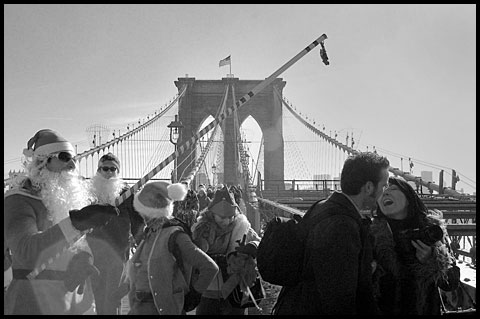
I've been looking at a great deal of photography lately: street photography, documentary photography, digital photography, and just-plain photography.
If I see one more photograph which could be described in the following manner, I will scream:
A person stands before the camera with a surprisingly empty look on their face.Please, can this go out of fashion sometime soon?
Above: Mistletoe, Brooklyn Bridge.
Sunday, September 03, 2006
Photography Unmasked
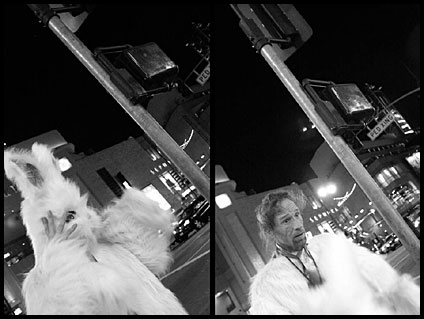
I'm puzzled by the fact that concern for "photographic truth" seems to be on the increase. I'm tired of hearing media reports that claim to be "shocked, shocked" at "faked" images. I'm also tired of reading that an exhibition "examines a contemporary notion of photographic reality," as a review in this month's Aperture Magazine claims.
Is it that the folks who write about such things do so in an overly-complicated manner? Let me be clear, then:
There is no photographic truth. There never has been. It does not matter. Let it go. Now go make some pictures.
Saturday, September 02, 2006
I Hear Weegee Laughing

I've been trying to decide on a small point-and-shoot camera to carry around. One that will fit in a pocket, but still make good street photographs when I stumble on an interesting situation.
Ironically, I was thinking about this on Friday morning as I walked along 86th Street and saw the sidewalk ahead closed off in police tape. I thought about it more as I got closer, and saw several police officers walking about and staring at the ground. Scattered at their feet: a stack of cash, green bills fluttering, splashed red from an exploded dye-pack.
I thought about it very hard as I walked past, no photograph made.
Above: an image from my street photography portfolio Waiting for the April Fool's Parade (copyright 2006 Ted Fisher).
Friday, September 01, 2006
This Weekend in the Galleries
Take the weekend off. Take a deep breath, and prepare for an endless stream of New York gallery openings in the next two weeks. My plan is to see everything, but here are a few suggestions to get you started:
Ron Galella at Paul Kasmin Gallery, 293 Tenth Avenue.
(Opens Wednesday, September 6, 6-8 p.m.)
Hey, Hot Shot! at Jen Bekman, 6 Spring Street.
(Opens Thursday, September 7, 6-8 p.m.)
Nancy Burson at ClampArt, 521-531 West 25th Street.
(Opens Thursday, September 7, 6-8 p.m.).
Nathan Lyons at Bruce Silverstein Gallery, 504 West 22nd Street.
(Opens Saturday, September 9th, 6-8 p.m.)
Thursday, August 31, 2006
It Keeps Me Off the Streets

I've let my camera rest these last two weeks while I've been editing the last project and sorting out the next. So, of course, I have had a number of unphotographable moments. Three I have missed:
A man with Down's Syndrome gently swinging a child's purse and hitting an older man again and again. (The older man said: "Since you are going" whack "to live with me for two weeks" whack "we're going to need" whack "to establish" whack "some ground rules.")
A man walking casually down 1st Avenue with a plastic bag over his head, seemingly quite comfortable and at home in his bag.
A couple kissing so intensely on the steps of the Metropolitan Museum that even New Yorkers turned to look.
Above: an image from my street photography portfolio Waiting for the April Fool's Parade (copyright 2006 Ted Fisher).
Tuesday, August 29, 2006
An Artist Deals with Banality

And how do you find the mystery in the banal?Above: an image from my street photography portfolio Waiting for the April Fool's Parade (copyright 2006 Ted Fisher).
Garry Winogrand: Well, that's what's interesting. There is a transformation, you see, when you just put four edges around it. That changes it. A new world is created.
Does that discreet context make it more descriptive, and by transforming it give it a whole new layer of meaning?
Garry Winogrand: You're asking me why that happens. Aside from the fact of just taking things out of context, I don't know why. That's part of a mystery. In a way, a transformation is a mystery to me.
Monday, August 28, 2006
Street Photography or Documentary Photography?
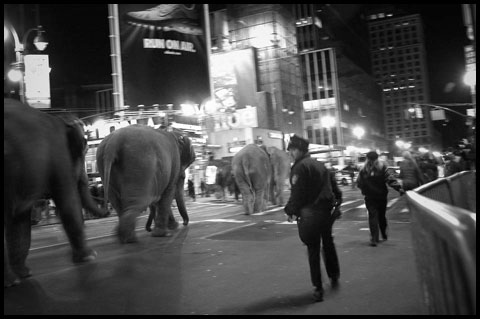
If there were an actual April Fool's Parade -- instead of just a way of looking at passing daily life -- it would be the perfect test for whether one wants to practice Street Photography or Documentary Photography.
In my take -- and I'm perfectly willing to let everyone invent their own version -- two photographers might show up at the same parade. The first, practicing documentary photography, will stay with the parade, and end up telling some story out of it, though perhaps not the obvious one....
The second, engaged in street photography, will be distracted by something, somewhere off to the side of the parade route, something vaguely beautiful but difficult to see....
Above: an image from my street photography portfolio Waiting for the April Fool's Parade (copyright 2006 Ted Fisher).
Sunday, August 27, 2006
What I Saw on the Walls

This weekend's viewing included visits to the International Center of Photography, the Neue Galerie and the Metropolitan Museum of Art.
Weegee's street photography (showcased in ICP's Unknown Weegee) is fantastic, but presents a curatorial dilemma every time it is shown. Weegee's body of work is large and uneven. Do you trim a show down to the absolute gems, and lose the sense of the day-to-day Weegee, grinding out photos for cash, or do you show the less-fantastic images to tell the full story -- and thus leave Weegee's reputation suffering in comparison to photographers we only know from their best images?
Gustav Klimt's Adele Bloch-Bauer I -- now known as "the most expensive painting in the world" -- has made the Upper East Side's Neue Galerie a very crowded place this summer. It's a case study in how different an object can be from its photographic reproduction. Spend time with this painting in a book or on a computer screen, and then see it in person for two minutes... and decide for yourself.
It's the third time I've seen the Met's On Photography: A Tribute to Susan Sontag. It's an excellent show that works as a collection of images, and as a way to consider the nature of photography -- and whether it functions differently than any other art.
Above: an image from my street photography portfolio Waiting for the April Fool's Parade (copyright 2006 Ted Fisher).
The Untimely Death of Henri Cartier-Bresson

Popular Photography has an interesting tidbit on Henri Cartier-Bresson:
The French photographer had been captured by Nazis in 1940, and he had spent 35 months in various prisoner-of-war camps. After two unsuccessful attempts at escape, he finally succeeded. In 1943, he dug up the Leica he had buried on a farm near Vosges and began taking pictures again.As always, chance works on its own terms.
By the end of the war, however, rumors reached America that Cartier-Bresson had been killed. MoMA's photography curator, Beaumont Newhall, went to work on a major show. Then, in 1946, it was learned that he was still alive. Cartier-Bresson decided to come to America to work on the exhibition -- a show that helped to establish him as a major figure in photography and art.
Above: an image from my street photography portfolio Waiting for the April Fool's Parade (copyright 2006 Ted Fisher).
Subscribe to:
Posts (Atom)