Sunday, October 18, 2009

Final Cut Pro Without A Mouse, Part One

Want to work fast in Final Cut Pro? Learn to work without the mouse.

Oh, you'll need the mouse sooner or later. Some tasks are best done with the mouse. If you want to edit fast, however, you may want to learn a few useful key commands that will speed up your editing process. Besides: it's cold and flu season, and who knows what's on that thing. So let's try a little mouse-free editing.

Get prepped:
Let's do the basics first so you'll be ready for this adventure. (In fact, you'll probably do this step with the mouse, just to keep things simple, but that's okay.) Start Final Cut Pro.

First, you'll need some sort of video clip to work with. You should have your "easy setup" set to match -- so if the clip is in DV-NTSC format, set your "easy setup" (located under the Final Cut Pro menu) to the same format. Close any project that's open, choose New > Project and then save it somewhere using an easily-understood filename and keeping the .fcp suffix.

Now choose New > Sequence and give it a name you'll understand -- like "tedshandsfreeedit01" or something appropriate. You don't want "Sequence01" or anything default or unclear.

Now, let's import your video file: choose File > Import and select your file. Set that mouse aside and let's practice. Hit Control-u to change to the standard interface. That will arrange your windows in a way that's good for the type of work we'll be doing.

Now let's work.
  • Hit Apple-4 to activate the Browser window.
  • Use the Up-arrow and Down-arrow keys to select what file is active. When you are on the video file you want to work with, hit the the return key and that will "load" the video clip into the Viewer window and activates the Viewer window.
  • Now you can use the j, k and l keys to move the playhead around. Tap "l" and the playhead will move forward at normal speed, tap it more and it will move forward faster. Hitting "k" will pause. Hitting "j" will move the playhead backwards; hitting it more will move the playhead backwards faster. The spacebar can also be used: it toggles "play" and "pause." To move by single frames, use the leftarrow and rightarrow keys. To move in one-second intervals, hit shift-leftarrow or shift-rightarrow.
  • Move to where you think a useful part of the clip starts. Once you have your playhead there, hit the "i" key to mark your inpoint.
  • Move to where you think a useful part of the clip ends. Once you have your playhead there, hit the "o" key to mark your outpoint.
  • Now, let's preview if you have the right inpoint and outpoint. Hit shift-\ and you'll see the clip play from the inpoint to the outpoint. If it is wrong, move the playhead to a better point and hit "i" or "o" to set a new better point.
  • Once you have the clip like you want it, hit apple-u to make a subclip.
  • You will see this new clip appear in the Browser. It will have jagged edges (note that the main clip has smooth edges) and it will have the text selected -- it's ready for you to type in an appropriate name. Like "Moe pokes Larry in the eyes" or something that will later help you identify the clip.
Now, repeat these steps and you can make subclips out of your single video clip, all ready to edit or to hand over to another editor. How do you get those on the timeline and edit them? That will be in our next edition of "Final Cut Pro Without A Mouse."

Saturday, October 17, 2009

Booked

My friend Doug McCulloh was in town for a few days. You should probably buy his books:


Thursday, October 15, 2009

Oh, Snap


Had a good studio lighting session in Seriously Fun Photography. Above: what happens when a strobe fires while taking an iPhone snapshot.

But First, Arm Wrestling And A Slap Fight

I really enjoyed this post by Maria Lokken. One of the reasons I have my students read books by both Walter Murch and Ralph Rosenblum is to give them a sense that often the relationship between director and editor is more important than just knowing how to edit. No matter which role you are playing -- or if you are both -- the process of moving from production phase to editing phase can make or break a film. If the wrong goal is set, or if the wrong parameters are drawn, the editing process will not lead to a great outcome.

So how can a director make that process work?

Working with an editor
"Once I hand everything over I walk away. Yes, walk away. Let him or her work with it like a sculptor with clay. Let them put their creative stamp on it, and see where it takes the piece. You can always pull back. But it takes longer to get something out of an editor if you’ve shut them down from the beginning by saying this is the way it has to be, no changes, no exceptions."

Wednesday, October 14, 2009

Adobe Photoshop For iPhone


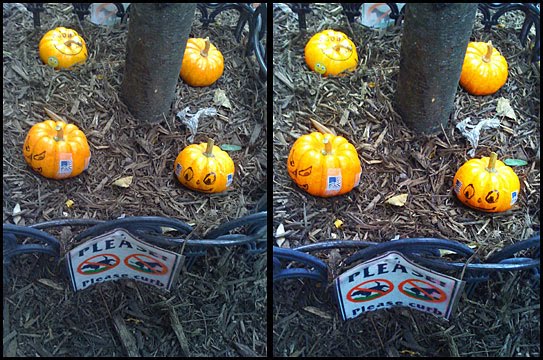
Above: I took a snap of a micro pumpkin patch on 89th Street this evening. It was a great opportunity to test out Adobe's Photoshop for iPhone.

Here's the process: I clicked on the Photoshop icon, and it asked if I wanted to take a photo or use an existing image. I chose the image, then used the crop tool to take out some unneeded detail, turned the saturation slider to plus 10, turned the exposure adjustment up a little, and chose to exit and save. That's it. The photo appeared in my phone's photo library and was ready to post. The original is at left.

It's a very simple app, it's free, and it does the basics. Not bad at all.

Tuesday, October 13, 2009

Sunday In The Park With Joel

Is there any news from the world of photography? Tons of it. Joel Meyerowitz in NYC parks, for one.

Documentary Photographer Turns His Lens on City Parks
In the latest phase of his career, Mr. Meyerowitz, 71, has turned his lens onto nature and wildlife in city parks, in a project evocative of the work of the artists and writers hired by the Works Progress Administration during the New Deal. The city’s Department of Parks and Recreation has commissioned a series of expansive photographs of city green spaces from Mr. Meyerowitz. The resulting works — 90 photographs — are now on view in an exhibition, “Legacy: The Preservation of Wilderness in New York City Parks,” that opened on Friday at the Museum of the City of New York."

Rock Followup: Hair Still Good

News from the world of documentary lawsuits.

Woman Declares Chris Rock's Documentary 'rip-off', Case Dropped
A judge in Los Angeles District Court dismissed a plagiarism lawsuit against Chris Rock that claimed the comedian lifted a woman's ideas when he filmed a documentary about African-American hairstyles.

Ted's Ideas On Editing Chase Scenes

On Wednesday I'm giving a lecture in one of my classes on editing chase scenes. I've given it a few times before, and it's usually a pretty big hit -- it seems to really help students get a handle on some basic editing concepts.

They may never edit a chase scene, but the bigger point is that they learn to develop a rational plan to make an otherwise complicated and confusing set of shots seem completely coherent, comprehensible, and clear.

We look at clips from about a dozen films, and illustrate the ideas below.

BIG IDEAS OF CHASE EDITING -- AND HOW THEY APPLY TO ALL EDITING

1. IDENTIFICATION
How do we know which character is which? Does one wear a white cowboy hat and the other a black one? Does one have a red car and the other blue? Is the pickup basketball game shirts versus skins?

2. LANDMARKS
If we see the leader pass the big red building, then ten seconds later the other, we know how far apart the characters are. Often, a camera will stay at a landmark position, and pan from one character to another.

3. ADVANTAGE
If a car is chasing a moped, the car has a clear advantage. But when the moped goes into the subway and the car driver follows on foot, now the moped has the advantage.

4. STATUS AND STRENGTH
Is a character gaining or falling behind? A shot where the camera is pulling away, or where the character is catching up to the camera may tell us. A shot with both characters in it might reveal the relative status as well.

5. EMOTIONAL STATE AND ATTENTION
We want to know what the character is thinking, feeling and doing -- so a cut to a shot through the windshield might reveal the character's expression. Or a cut to the foot on the brake might tell us what's happening. Or a closeup on the gear shift. Make careful note of where the character looks -- the next shot might be their "point of view."

6. CAMERA POSITION
A camera can be low in the front of a car, can look out the rear window, can sit in the passenger seat, can look down at the brake pedal -- and all of these shots are useful. It can run alongside the moped as it plunges down the stairs. It can turn to watch the car streak by. It can shake, float, or fly.

7. SCREEN DIRECTION
If a car goes from screen left to screen right, we expect it to keep doing that unless we some change -- a shot where it turns, or where we "move" into the car before coming back out. And we expect the car chasing to also maintain consistent screen direction -- unless we see a change happen.

8. SOUND
If we cut from the big black car to the little red sports car -- should the sound change right on that cut? Or should it change in other ways? Do we want to hear the sound of the car coming toward us, then going away?

9. TAKE A PACING BREATHER
Even in a short chase, all go-go-go action wears thin. It's usually more exciting to have a lot of action, then a tiny pacing "deep breath" before the big finish.

10. CUT TO THE CONSEQUENCES
That tank chasing the laser-guided skateboard just knocked over every fruit stand in aisle 19. Maybe we could cut back to see what happened, and the angry manager shaking her fist at us? Or maybe our wheel can't take much more and is starting to wobble -- maybe a closeup to reveal that?

Touching Retouching

Great article about students in Baltimore who salvage photographs, then use Photoshop to restore them. I think there's something in my eye.

High school students try to save neighbors' memories
"The Patapsco photography class was spending part of Monday afternoon examining their first batch of work: photos from the flooded basement of Jane Haines. Haines lives in Logan Village, one of the communities affected last month by a main break that sent water gushing into more than 100 homes in the Dundalk area. Throughout this month, the students are offering to digitally restore photographs ruined in the deluge."

Monday, October 12, 2009

Party Like It's 1993

Is it just me, or is a lot of the current conversation about the future of film distribution very similar to the discussions folks had in the early 90s about the future of the Web?

I have a book about the "future of art" on my shelf, printed just as the World Wide Web came along. Its predictions are completely wrong. I remember all the excitement about media moving to CD-R. That's faded away, though you could certainly do that today easily -- but no one wants to. And I remember many people who were very adamant that they would never read on a computer screen or buy online. Others said they'd never visit a page with advertising.

I streamed a live video conference in 1997, put streaming video online not that long after that, and have made a lot of work for the Web -- so I'm not surprised by the changes that have happened.

What I don't get, the part that is surprising to me, is how flat-footed people in the film production world have been caught by the changes. I think it's being explained in the wrong terms: it's not that you can't make a film, and it's not that you can't distribute a film. Those things are actually easier than ever. The problem is that they no longer make financial sense. The financial system in place works fine at a certain scale, but doesn't work under the new conditions. There's pressure to make Transformers 8 or a YouTube video of your hamster.

The stuff in the middle -- the good stuff -- needs a new model.

Eggnog All Around


As of this weekend, stores were ready. Break out the Santa suits.

Sunday, October 11, 2009

He Told Them To Rush, More

Does Wes Anderson's Director of Photography really think he's a butthead, or is this a planned P.R. stunt? Either way, today's Los Angeles Times article on the retro stop-motion process behind The Fantastic Mr. Fox is a very interesting read.

Fur flies on 'Mr. Fox'
Not everyone could muster a magnanimous word for Anderson's M.O. -- especially his on-set absence. "I think he's a little sociopathic," cinematographer Oliver said. "I think he's a little O.C.D. Contact with people disturbs him. This way, he can spend an entire day locked inside an empty room with a computer. He's a bit like the Wizard of Oz. Behind the curtain."

Informed of Oliver's discontent, Anderson said: "I would say that kind of crosses the line for what's appropriate for the director of photography to say behind the director's back while he's working on the movie. So I don't even want to respond to it."

Saturday, October 10, 2009

IMDB Web Series Credits Update

A while back -- on April Fool's Day, unfortunately -- I posted about IMDB Web Series Credits. Casey McKinnon had just announced the result of her conversation with Col Needham, IMDb founder and managing director: IMDB would be creating a Web series category.

She's still waiting, and has an update....

I want my… I want my… I want my Web TV!
"How much longer do we need to wait? How much longer must we submit our web series as “TV Series” or (straight to DVD) “Video” titles? I sent Needham an email the other day asking for an update, and just sent an email through the IMDb contact page last night. If you’re a producer with the same concerns, I suggest trying to touch base with them through your own networking channels. Let’s get this pushed through!!!"
Of course, maybe IMDB has been busy. They did, after all, add Twitter.

Long Enough To Reach The Ground


What's the right length for a film? Esquire Magazine makes one argument:

The 90-Minute Movie: Because 80 Minutes Is Too Short, and 100 Is Too Long
They could have cut out the entire China subplot from The Dark Knight — easily 20 of that movie's 152 convoluted minutes — with no effect on your enjoyment or comprehension of the film. And was it me, or did the fifth hour of The Curious Case of Benjamin Button start to drag?
Also, the list of films shortlisted in the Academy Awards short documentary category was released this week: almost all of them, as usual, 39 minutes long. Many are really films made for the 52-minute television hour, but cut down to 39 to take a shot at Oscar recognition. No nomination? Put 13 minutes back in, go to cable. (There have been a few exceptions over the years, notably the 17-minute Two Hands: The Leon Fleisher Story (2006) by Nathaniel Kahn.)

Oscar short documentary contenders named
Thirty-seven films were submitted in the short doc category and on Friday the Academy's documentary branch released a list of the eight films that have been short-listed. Three to five of them will be nominated when the nominations are announced on Feb. 2.
Above: The Quad, on 13th Street.

Friday, October 09, 2009

Marathon Women


Many of the films from the International Documentary Challenge can now be viewed on Snagfilms. Above: Marathon Women, a 5-minute doc made by two friends of this blog for the 2007 competition. Enjoy, and remember you can "snag" the film and embed it anywhere.

34th Street Revisited


Friday evening I found myself standing in the same spot where the end of Blind Faith: A Film About Seeing was filmed.

Above: an iPhone snap from that spot.

Thursday, October 08, 2009

Speaking Of Snapshots


Above: an iPhone snapshot on 91st Street earlier this evening.

The Snapshot Gap

All those U.S. presidents who had brush-clearing as a hobby, take note: there are better ways to spend your time away from starting pointless wars.

Dmitry Medvedev, Russia's Photographer-in-Chief?
"A wide shot of a rising moon, a macro close-up of an icy branch and flames dancing in the darkness are a small taste of the photos in a large collection of personal photography by Russian President Dmitry Medvedev the Kremlin has posted online."

Seriously Fun Photography, Session Two

Last Thursday night was the second session of Seriously Fun Photography

We reviewed what we learned Week One then thought again about the relationship between aperture and depth of field. While we start to get the idea when we say "f/2 -- shallow depth of field and f/22 -- deep depth of field" actually trying this out in with some real world shots is always a good experiment. So, to make a photo where a person is in focus but the background is out of focus, we did the following:
1. Set your zoom lens toward telephoto -- 50mm or longer -- or use a telephoto lens. 90mm would be an excellent choice.

2. Set your aperature toward f/2 -- on most basic zoom lenses, you might only be able to go to f/3.5 or f/4 or f/5.6, but that's okay. If you can get closer to f/2, that will work even better.

3. Position yourself, your subject, and the background. Generally, you should be close to your subject and the background should be far away to achieve this result.
We experimented, and soon everyone was able to produce a photo with the subject in focus and the background somewhat out of focus. This is a great way to emphasize the main subject of the photograph.

We then went on to begin the long and complicated process of thinking about compositional strategies. For example, we introduced the "rule of thirds" -- which I have posts on here and here and here.

We then looked at how to create a relationship in a photo -- between a subject and the negative space around them, between two or three people, and in various other senses.

Nearer the end of class, we looked at ways to think about the space we are photographing in and how this can change / work with our compositional idea.

Wednesday, October 07, 2009

Documentaries In The News

With all the talk of documentary distribution, I guess one tried-and-true plan hasn't been discussed enough. That's right: suing the heck out of somebody.

Chris Rock sued over Good Hair film
Kimbell said she screened the film for Rock back in 2007 on the set of Everyone Hates Chris. Like Good Hair, My Nappy Roots traces the business and cultural history of black hair care and interviews celebrities about their hair stories. It has been shown at colleges and film festivals since its completion in 2006.

Color On The Street


Thursday night I teach my photo class at Hunter Extension. I've asked the students to tune in to color during the week, so I've tried to as well. Here's an iPhone snapshot from this morning, probably taken at 1st Avenue and 89th Street.

Parallel Eye-Jabbing Action


Today I taught my editing class, emphasizing smart and fast technique. When the students came in, each computer was ready to edit -- but the mouse was hanging off the desk, useless.

"Don't touch it," I told them. "The mouse is for weak-minded people. Today we edit like adults."

Which was true, and by the end of the class even the most hesitant students were able to make subclips and perform insert and overwrite edits with keys-only technique. It was very .... grown up.

Except for one thing: we were editing clips from a Three Stooges movie.

Call It "Barking Mad"

In these difficult economic times, newspapers like to give their readers a glimpse at alternative, wacky careers. You know, like photography.

How hard is it to photograph a wedding?
"The memorable shots from Marc and Sylvia Day's wedding are unusual, to say the least. Decapitated guests, a ceremony hardly visible through the gloom, and random close-ups of... not the bouquet, or a snatched kiss, but of carriage wheels."
The noisy art of pooch photography
"When the gadgets don’t work, Schwartz mimicks animals, woofing, mooing, clucking, sometimes resorting to bogus sneezing and the occasional raspberry; whatever it takes to garner cooperation from his subjects, who tend to be preoccupied by their surroundings."
I like the idea of a situation comedy about a pet photographer forced in hard times to shoot weddings -- keeping the tactic of making animal noises, of course -- or maybe something on the world's worst wedding photographer. More likely: a reality show where pet photographers and wedding photographers switch jobs for the day.

Monday, October 05, 2009

Photography In The News

Brian Duffy, for most people who follow photography, is not the first name to come to mind. Say "David Bailey" and a particular place and time and attitude will come to mind. But Duffy?

He was right there, though, part of the "Terrible Trio" with Bailey and Terence Donovan. Swinging London. Picture David Hemmings in Blow Up. So why isn't he remembered?

For one: he quit photography. Also: he burnt quite a bit of his work.

Why would you burn your life's work?
"One morning I came into work, my assistant said we haven't got any toilet paper. I was employing four staff, was managing director, head of this organisation and my decision was on toilet paper. At that moment I cracked. Later that day I burned something, then I went into burning mode. I got reported and the council came round. "They were in a big bin. I was making a lot of smoke. Negatives don't burn easily. They make a hell of a lot of smoke."

Sunday, October 04, 2009

Happy Holidays


It's October. Duane Reade is ready.

Documentary Digital Distribution Dollars Delineated

Scott Kirsner has an article and followup on the current state of independent film distribution through online venues -- and actually provides some hard numbers to consider.

The numbers:
One of the most popular documentaries on iTunes brought in over $100,000 from downloads; Apple gives a 70/30 revenue split. Typical results are more like $1,000 per title over a year, however.

Netflix pays a flat annual fee; one source claims the one-year rate ranges from $1,000 to $10,000 for the "Watch Instantly" streaming service.

Hulu is bringing in 6 million unique visitors each month, but mostly for the mainstream material, not the indy material.

SnagFilms appears small next to Hulu, but its distribution model (you "snag" the film and put it on your own site) means it's probably larger than initial reports; it also feeds some documentaries to Hulu.

The most significant point, I think, is just hinted at in the article: indie films, especially documentaries, now need a smartly timed release cycle. Get the film into festivals, get the media talking about it, then find a way to sell viewings in a cycled release: maybe $9.99 early, then at lower rates as the cycle cools. Maybe the long tail is DVD sales, maybe it's pennies per click via advertisements inserted into "free" viewings. Theatrical release or a cable purchase can happen in the middle, but this hasn't been a great year for that, really.

Indies still looking for Internet equation
'One thing the Internet has clearly changed, observes distribution consultant Adam Chapnick, is access to an audience. "But having easy access to the global audience doesn't get anyone to see your movie," he says. A solid marketing strategy, whether traditional or digital, is still essential.'
An Update on the State of Indie Film Online
'Rick Allen, CEO of doc-streaming network Snagfilms, takes issue with the traffic figures I cited in the story, supplied by Compete.com. Compete says the Snagfilms site gets about 100,000 unique visitors a month, compared to about six million for Hulu. Allen accurately points out that some of Hulu's most popular full-length films actually come from Snag (like 'The Future of Food' and 'Super-Size Me.') And he argues that a lot of Snagfilms content is viewed on other sites, describing Snag as "a massively sub-distributed network."'
By the way, did I mention you can see Blind Faith: A Film About Seeing on SnagFilms? For "free" -- so watch it over and over.

Saturday, October 03, 2009

Pointing And Laughing At "Persistence Of Vision"

Look, here's the deal: the concept of "persistence of vision" was discredited decades ago. People who write about it and tell me it's a very important concept are dumb. It's not even a coherent idea, which tells me these "writers" are just taking the ideas handed down to them from other people and pretending to understand them -- and then they are "teaching" those ideas as if they were true. Makes one wonder what else they are teaching.

So, in the interest of public service I'm going to start calling people out on it. I'm going to start pointing and laughing at people who write about "persistence of vision" as if it were still a valid idea.

Just so you understand how long this has been discredited as an idea:

THE MYTH OF PERSISTENCE OF VISION REVISITED

That paper was published in the Journal of Film and Video in 1993, and it complains that a previous paper -- published in 1978 -- hasn't put a dent in the constant renewal of this discredited notion. They point out it really has been proved wrong SINCE 1912, yet keeps returning.

So, who's "teaching" about the importance of "persistence of vision" today?

Understanding Video: A Video Primer for Photographers
by The Luminous Landscape.
"Because of something called the "persistence of vision" (the human eye hangs onto what it sees for a small while) these two fields merge in our brains. Incidentally, it's this persistence of vision that allows us to see a 24 frame per second movie as continuous motion rather than a series of flickering still images."
That's simply not true. Stop it, please. Ask yourself: why do I think this is true? Has anyone ever shown me that it's true? Or have I just heard it or read it somewhere -- and believed it? If you can't verify it, why are you teaching it? What do you mean by images "merging" in our brain? How do you know that? What evidence do you have for it? If there's none, please stop publishing it.

Friday, October 02, 2009

Doc On A Stick

One swallow does not make a summer, but two documentaries on USB flash drives? I think that marks a trend.

Mann releases mushroom doc on USB stick
Canadian director Ron Mann is testing a new method of movie distribution, releasing his documentary Know Your Mushrooms on a customized USB stick. The Toronto-based filmmaker was in the U.S. promoting his new doc — which follows mushroom-hunting gurus and explores mushroom culture — when he discovered a company that creates these flash drives in different shapes, including that of a mushroom.
Limited Editions and Blu-ray Disc!
We’re pleased to announce two limited-edition versions of Objectified designed by our friends over at Build, and the Blu-ray disc edition of the film. Available for pre-order now! USB Limited Edition: Fixed media? Meh. We’ve put a digital copy of the DVD on a tiny, custom-printed 16gb USB drive. Copy the file to your hard drive, watch the movie, and then use the nice little USB stick for all the things you normally use a USB stick.

Thursday, October 01, 2009

Update on Polanski Doc

On my other blog, there's a little more on the revelations about that documentary on Polanski. Less Hypothetically

Less Hypothetically

indieWIRE has more on an incident that will surely appear in future textbooks on documentary ethics: what happens when the subject of your film says they lied?

“Desired” Director Zenovich Responds To Polanski Prosecutor’s “Lies”
Zenovich said that the day she filmed Mr. Wells at the Malibu Courthouse, he gave her a one-hour interview. “He signed a release like all my other interviewees, giving me permission to use his interview in the documentary worldwide,” she said. “At no time did I tell him that the film would not air in the United States.”

She went on to say she is “astonished” that Wells has changed his story. “Mr. Wells was always friendly and open with me,” she said. “At no point in the four years since our interview has he ever raised any issues about its content. In fact, in a July 2008 story in The New York Times, Mr. Wells corroborated the account of events that he gave in my film… It is a sad day for documentary filmmakers when something like this happens.”

Wednesday, September 30, 2009

Ah, Documentary Ethics Is Always In The News

A little documentary ethics question: if you make a documentary, and many people cite it as evidence in an international legal battle, and then your interview subject admits that he lied about a key piece of information that became central to the film -- just made up the story -- what's the next step?

I ask this hypothetically, of course.

“The director of the documentary told me..."

Marcia Clark reports that David Wells lied in Roman Polanski: Wanted and Desired.

Polanski's Lost Alibi
'“I lied,” Wells told me yesterday, referring to his comments in the movie that he told the judge how he could renege on a plea bargain agreement and send Polanski back to jail after he had been released from a 42-day psychiatric evaluation—the heart of Polanski’s claims of prosecutorial and judicial misconduct. “I know I shouldn’t have done it, but I did. The director of the documentary told me it would never air in the States. I thought it made a better story if I said I’d told the judge what to do.”'
Will this change the position of the 100+ directors who have signed the petition supporting freeing Polanski?

Besides removing one of the arguments those supporting Polanski have used, it leaves one curious about the process of interviewing Wells. Will the production of the documentary become a discussion in the -- already overflowing -- set of ethical questions documentarians face?

Tuesday, September 29, 2009

Mornington Crescent?


On my other blog, some ranting about the news.

Above: a much less unpleasant snapshot from a subway station. You guess which one.

Carl Schurz Park


I always forget Carl Schurz Park is one block from our apartment. Mrs. New York Portraits and I went for a walk at sundown tonight, through the park and then along East 78th Street. I'm not sure why I like 78th so much, but it feels very neighborhoody to me.

Above: an iPhone snapshot, looking toward the Queensboro Bridge.

Polanski Update

I posted yesterday that Facts Matter in the Polanski case. Since then, many incredible directors, authors, and others I respect have come out in support of Mr. Polanski.

I am still correct, and they are still wrong -- no matter how wonderful they are in all other ways..

I am embarrassed that they have come out in support of this man's actions, as support for an admitted child rapist is a stain on their reputations. I believe the facts will be revealed. I expect some of them may have signed the petition based on their misperception that this was a charge related to consensual sex. A thirteen year old cannot give consent -- and the court testimony reveals she said no, told Mr. Polanski to stop, and resisted in other ways.

There's much more to this, but I want to repost fact one, a fact you can check yourself and decide for yourself: Go and read the victim's testimony, starting on page 26 and count how many times the 13 YEAR OLD GIRL said "NO" and "STOP" and indicated she did not want to stay or for Polanski to continue.

I think that is rape. You may feel otherwise, but I think that's clear.

Whoopi Goldberg doesn't seem to think so, and she is wrong. As are Salman Rushdie, Milan Kundera, Mike Nichols, Claude Lanzmann and Woody Allen.

I'm aware of what seems to be judicial misconduct regarding the sentence. Please note -- not judicial misconduct while determining the facts. Mr. Polanski admitted the facts of the case.

I think Mr. Polanski should appeal because of what happened with the sentencing. Perhaps he will be given time served, perhaps he will be given a substantial sentence. He does not get to decide -- a judge or jury does.

Even if he were given no further time to serve, the facts of the case will not change: the evidence says he drugged and raped a 13-year-old girl. There were six charges against him, the outcome was a plea agreement to a lesser charge.

I am embarrassed for those speaking out for him. He committed a crime, and fled when he did not like the sentence he would receive. He did not stay and begin an appeal, he did not argue his case in the media, he fled. And now he's been apprehended. It's a matter for the courts, not for film directors and television hosts -- especially if they have not read the facts of the case.

Yes, I've seen the documentary on the matter. As always, I'm for documentaries on difficult issues. Yes, I'm aware his victim does not want him to serve more time.

But the main point here -- that smart people are signing a very stupid petition, calling for the release of a man who fled sentencing and who did not serve the time decided by the state of California for a crime he admits committing -- stands. Mr. Polanski, by his own admission, committed very serious acts. I cannot support his inability to be man enough to stand up to the charges and I cannot support this misguided petition in his name.

Monday, September 28, 2009

Facts Matter

Facts are simple and facts are straight
Facts are lazy and facts are late
Facts all come with points of view
Facts don't do what I want them to

-- Talking Heads, 1980
Here's the thing. I love film people. In general, they're very smart. Maybe, though, sometimes, when it's so easy to get the attention of the media, they are a little impatient with inconvenient facts. So I feel very bad about the report that people I think are great filmmakers -- Wim Wenders, Wong Kar Wai, Wes Anderson, Tom Tykwer among others -- have (according to news reports) signed a petition demanding the "immediate release of Roman Polanski."

To start the discussion, here are two sources:

Over 100 In Film Community Sign Polanski Petition
'Wong Kar Wai, Harmony Korine, Stephen Frears, Alexander Payne, Michael Mann, Wim Wenders, Tilda Swinton, Julian Schnabel, and Pedro Almodovar are among the 100 and counting film industry figures who have signed the petition, coordinated from France by the SACD, an organization which represents performance and visual artists.'

Top directors rally around Polanski
'Posters were stuck on the cinema where Polanski had been due to receive his award, declaring "Free Polanski" and "No extradition". The director pleaded guilty three decades ago to having sex with a 13-year-old girl. His lawyer said Monday he had refused to be extradited from Switzerland to the United States. The 76-year-old fled the US in 1978 before sentencing on a charge in the underage sex case. He has never returned, even missing the Oscar award for "The Pianist" in 2003. France's Society of Film Directors also voiced concern the arrest "could have disastrous consequences for freedom of expression across the world".'
I firmly believe these directors are on the wrong side of this.

Go and read the victim's testimony, starting on page 26 and count how many times the 13 YEAR OLD GIRL said "NO" and "STOP" and indicated she did not want to stay or for Polanski to continue. I'm not a lawyer or a judge, but I believe that's rape.

The Swiss Directors Association petition refers to this "a case of morals" and, in fact, the case was plead to "a felony count of unlawful sexual intercourse" -- but read that transcript and be clear this is not a case where a rock band's groupie turned out to be 17 and 1/2 to everyone's surprise. It's a case where there seems to be coercion, force, and the knowledge that the victim is 13. Remember that in a plea bargain, the procedure generally moves toward agreement on a lesser charge -- in this case, it seems, to avoid forcing a 13-year-old rape victim to testify.

As another source explains:

Reminder: Roman Polanski raped a child
"Before we discuss how awesome his movies are or what the now-deceased judge did wrong at his trial, let's take a moment to recall that according to the victim's grand jury testimony, Roman Polanski instructed her to get into a jacuzzi naked, refused to take her home when she begged to go, began kissing her even though she said no and asked him to stop; performed cunnilingus on her as she said no and asked him to stop; put his penis in her vagina as she said no and asked him to stop; asked if he could penetrate her anally, to which she replied, "No," then went ahead and did it anyway, until he had an orgasm.

...

The point is that drugging and raping a child, then leaving the country before you can be sentenced for it, is behavior our society should not -- and at least in theory, does not -- tolerate, no matter how famous, wealthy or well-connected you are, no matter how old you were when you finally got caught, no matter what your victim says about it now, no matter how mature she looked at 13, no matter how pushy her mother was, and no matter how many really swell movies you've made."
I think the petition-signers have one point: an arrest like this at a film festival is shameful. If that's where the petition stopped, I might understand. But the arrest is fugitive Polanski's shame -- if you choose to run from the law, you bring this upon the festival. This is not a case of political amnesty from repressive dictatorship. If, as so many of these directors seem to think, Polanski can show judicial misconduct -- then do so.

Of course, then one will need the facts to back that up.

Friday, September 25, 2009

William Eggleston on SnagFilms


One of my students brought up William Eggleston. And ... here he is.

(You have to be in the right mood for this. In a way, that's true about Eggleston's work as well.)

Sony's Secret Lab, Somewhere Off The Jersey Shore


So Canon, Nikon, Panasonic, and Pentax all have useable HD modes in their DSLRs now.

All have problems, the Panasonic GH1 being the smartest of the bunch so far -- and the closest to useable for documentary video. (The Canon 7D is also creating a lot of excitement among doc makers -- but the Panasonic still has the best implementation to date. It's just that people love their Canons, and associate it with "professional" and Panasonic with "consumer" cameras -- even though Panasonic has done wonderful things in video camcorders.)

Yet Sony -- which has pushed forward some very smart, very price-savvy products very quickly in its DSLR offerings but not gotten the respect it deserves -- says they won't implement video until it is fully cooked.

That's fine, just get cooking soon, Sony.

Above: an iPhone snap from last night's class.

Friday Film


I mentioned this film in class last night, so ... here it is.

Blind Faith: A Film About Seeing follows the Seeing With Photography Collective, a group of blind photographers working in New York. (You need Flash installed to see the video player above.)

Click the player above, or you can also see the film at: SnagFilms. (If you click "snag this film" you can embed it on any site.)

Thursday, September 24, 2009

Rhymes With Class


Well, the first "Seriously Fun Photography" class is all behind me now.

We learned that to control exposure, we need to work with three related elements: Aperture, Shutter Speed, and Sensitivity.

Aperture:
The f/stops to memorize are f/1.4, f/2, f/2.8, f/4, f/5.6, f/8, f/11, f/16, f/22. If you forget these, make two columns, and at the top of the left one write 1.4 and at the top of the right one write 2.0. Now double each number as you go down the column (rounding off when needed). Changing one stop lets in twice as much light (or half as much, depending on which direction you go. f/2 lets in a lot of light, f/22 lets in very little light. So if you took a picture using f/8 and it seemed a little too dark, you would switch to f/5.6. If you took a picture using f/8 and it seemed a little too bright, you'd switch to f/11.

Shutter Speed:
The common shutter speeds are:
1/1000th of a second
1/500th
1/250th
1/125th
1/60th
1/30th
1/15th
1/8th
1/4th
1/2
1 second.

-- As a rule of thumb, if you are moving and you're subject is moving, you'll want to be shooting at 1/1000th of a second to get a sharp picture.

-- If you are still but the subject is moving along, it would be good to be at 1/250th or faster.

-- If you and the subject are both relatively still, you can probably handhold the camera as slow as 1/60th, but slower than that and you'll get a soft picture because of camera shake caused by pressing the shutter.

-- At speeds that are slower, you'll need a tripod to steady the camera, and probably want to trigger it using the self-timer or a release.

-- Many decent cameras have higher shutter speeds, and these are very useful for action or sports.

Notice that the relationship of these shutter speed settings is also doubling (or halving) the amount of light that hits your sensor.

Sensitivity:
This is the ISO "speed" of a digital sensor or of film. ISO 100, 200, 400, 800, 1600 and 3200 are available on many cameras (but not all), and you should take some test shots with yours to find out if the higher ISO settings are usable or not. Figure out the fastest ISO speed you find produces acceptable shots on your camera -- you'll need to switch to it sooner or later. Notice that each ISO speed is twice as sensitive (or half as sensitive) as the next.

Then we decided to start applying our general knowledge about the relationship between apertures and depth of field. While we start to get the idea when we say "f/2 -- shallow depth of field and f/22 - deep depth of field" actually trying this out in with some real world shots is always a good experiment.

So we set up an experiment that can be repeated at home: set your camera on a table or a tripod, and in front of it arrange people or objects in a receding line. Put the first person or thing just 3 feet away from the lens, and have the furthest be at least 12 feet away. Now set the widest aperture you can -- I use a lens that goes to f/1.4 for this -- and focus on the closest person or object. You'll probably find that the people / objects behind that are out of focus. Now run through the whole series of aperture settings you have available (you'll probably want to be in "aperture priority mode" so that the camera sets the corresponding shutter speed for an acceptable exposure. Or you can set that yourself). Try this and compare each shot -- more and more will be in focus until you should be able to get everyone in focus.

Now, keep in mind there's one other factor here -- the focal length you shoot with. Usually the effect of getting a main subject in focus and the background out of focus is much easier to achieve if you use a lens of at least 50mm or set as zoom to 50mm focal length or a more telephoto setting.

Many photographers think that "telephoto lenses have shallow depth of field and wide angle lenses have deep depth of field" -- it turns out that isn't exactly true, but for pragmatic purposes it isn't a bad way to think. If the goal is a sharp subject and a blurry background -- grab a 90mm or set your zoom lens about there.

(For a discussion on why the wide focal lens = deep depth of field idea isn't precisely true, read Do wide-angle lenses give you greater depth of field than long lenses?.)

Another thing that comes up at this point: some lenses allow your camera to reach to f/1.4 or f/2 or f/2.8, but many times the "kit lens" zoom that comes with a DSLR or the zoom lens built into a compact camera will not go to that wide-open an aperture. And to further add to the confusion: many common lenses that go from 18mm to 55mm (or 70mm) let you go to f/3.5 when using the widest focal length (18mm) but only to f/5.6 when you are using the long end of the lens (55mm or 70mm). That's just how those lenses are built.

Now, once we know a technique to control depth of field -- go towards f/2 to get a sharp person, blurry background or toward f/22 to get subject and background both focuses -- we want to think about why we would do it. Well, it's that kind of control that lets us emphasize or deemphasize what a viewer sees in a photograph, so we want to master it so we can control our images. Need to photograph a person against a cluttered, distracting background? Use selective focus. Need to show that a person has kids but keep the emphasis on the person? Use selective focus to make the kids visible but de-emphasized.

So, from a technical standpoint, as we approach any photo situation we'll want to decide on an ISO setting, a shutter speed and an aperture. The three are interrelated and all use a doubling / halving system so it is easy to calculate how to change them when needed.

Wednesday, September 23, 2009

Currently Reading


My current train reading -- read in 20 minute bursts via my iPhone -- is Documentary Film: A Very Short Introduction by Patricia Aufderheide. I'll write something on it when I'm finished. That will take a few more train rides.

De Chirico In The Bronx


This term I'm teaching one class in The Bronx instead of two. Which means instead of a trip north, a class, a break, a class, and a trip down to 86th Street, my day is train / class / train.

I like that significantly less, and it messes up my schedule, wipes out what remains of my energy and makes it hard to get everything done. Still, it's not a bad commute -- just long enough I can read a bit on the train.

Above: an iPhone snap from today.

Tuesday, September 22, 2009

Followed By Bad

So Festival A emails during the summer: "Please send Film X for our consideration."

"Huh," I say. "I didn't think that was a good match for that fest, but they must have some programming idea going if they've asked for it. I'll send it in. Maybe they'll go for it. That's really exciting."

The very next day, Festival B emails: "We'd like to see Film X -- we think it might be a match for a program we're putting together."

"Well, alright," I say. "It does seem like a match there. Never heard of them before, but it looks like it could be a good event. How exciting. Everyone wants Film X."

Dissolve to: Months later. Festival A emails: no thanks.

Cut to: Five minutes later. Festival B emails: no thanks.

That's how it goes. I then look at what films have been chosen:

"Ah, that one is good, and that one. Don't know the rest.... Wait. There's that one short film that's been screening at every fest I've been in recently. It's made by a filmmaker who has completed and sold multiple feature films. It's in -- in the Amateur Production category? What the heck?"

Did the filmmaker enter it in the "Amateur" category? Did the fest look at it and say "this is a great amateur production!" and select it? I guess I'll never know.

Monday, September 21, 2009

Congrats James Longley

A new round of geniuses. Don't have to put that in quotes, really.

For MacArthur Grants, Another Set of ‘Geniuses’
...other winners in the arts who have received public recognition are the documentary maker James Longley, 37, who explores Middle East conflicts with portraits of communities under stress;...

New Main Site

I've updated http://tedfisher.com/ with my filmography and c.v. and a few other useful links. I suppose it is now my "official site."

Good News


My Seriously Fun Photography class is a go. We meet for our first session Thursday night.

It's walking distance from my apartment, and we keep everything low-stress and high-fun. So I'm looking forward to it. (An advanced class is scheduled to start in six weeks, also, if enough people enroll.)

Above: an iPhone snap from today.

Linear Schminear


Today was the last day teaching linear editing. We're moving on to those newfangled computer thingies. Now the real fun begins.

On University Avenue


Above: an iPhone snap from today in The Bronx.

Sunday, September 20, 2009

Saturday, September 19, 2009

First, Check Her IMDB Page

One of the most common questions my students ask is about rates for video production. I tell them it can vary greatly, depending on many factors.

For example, are you sleeping with a presidential candidate?

For John Edwards, the Drama Builds Toward a Denouement
"The prosecutors are also examining some $114,000 paid by the Edwards campaign to Ms. Hunter for a series of short campaign videos she produced. About $14,000 of that money was paid to her well after the videos were produced, some through transfers from accounts and listed as for furniture purchases."
Maybe it really is A Golden Age For Shorts

Documentaries in the News

John Cage once told this story:
Artists talk a lot about freedom. So, recalling the expression “free as a bird,” Morton Feldman went to a park one day and spent some time watching our feathered friends. When he came back, he said, “You know? They’re not free: they’re fighting over bits of food.”
There's a sense, as the distribution system for documentaries seems to slowly implode, that there's a glut of content. So, a lot of documentarians are fighting over bits of food.

With the wind blowing in that direction, the Los Angeles Times asks:

Ken Burns: Was a backlash inevitable?
"While Burns is one of the best known and most watched documentarian of recent times, he has also acquired his share of detractors. Though he's generally respected by critics and scholars, a backlash has been building, dismissing him as middlebrow, charging that he's repeating himself, that he's too earnest, too dark or naively patriotic."

Friday, September 18, 2009

Law And Order


Had to go to the Court House today. They happened to be shooting Law and Order at the front of the building. Snapped this iPhone pic as I walked in.

A Golden Age For Shorts?

On my other blog I have a post up about Docunomics looking at how penny-per-view and "long tail" models add up, or don't. It started me thinking, though, about how this might change the way we think about feature films and short films.

Basically, for online distributors, the model is to put a commercial at the beginning of the video. In a short film, that's very simple: you watch a 15 second (sometimes longer!) commercial then see the short film. In a sense, that's the most direct translation of the original free television model, with the added bonus for viewers of choosing what they see and when, and the added bonus for advertisers in that they can precisely target an audience.

In feature-length films, however, it gets a little trickier. Generally, there's an ad at the beginning, then sometimes 4 or 5 ads inserted into breaking points in the film. If someone doesn't watch the later ones, there's no payment for those.

Well, think that through: a feature film, unless made as a no-budget effort with everything deferred, has a huge production budget. For narrative film, that's in the millions, for big-budget documentary that's in the 100,000s, for small-budget documentary -- if you are honestly counting everyone's deferred salary -- in the 10,000s.

Still, to an advertiser, one view is one view. If a 3-minute short gets someone to watch one ad, and the feature length film only gets someone to watch 5 ads, there's an interesting advantage to the short. Someone who made 5 incredibly-popular shorts could in theory match the online advertising revenue of one feature film.

Of course, good features become juggernauts: they get written about in the media, gain fans, get reviews, get nominated for awards. They are marketed, and -- usually, but not always -- cycle through film festivals, DVD sales, broadcast and DVD rental before going online. So the online ad money is icing on the cake.

It's interesting, though, that some advantages appear in this model for short films: many people are comfortable watching a short online, but don't want to spend 90 minutes hunched over a computer or wearing headphones. Someone not specifically looking for a film would certainly be more likely to impulse-watch a short than a feature, as well.

So while traditionally short films have been seen as a "training" area of filmmaking -- lower production cost in time, money and other resources, but less interest in general and usually no DVD sales except in collections (where the revenue is then split many ways) -- an ad view is an ad view, and online that might mean making many shorts could be a viable production model.

These are interesting times, no question.

Docunomics, Part Three

Many years ago, I took an unexpected trip to Las Vegas. No big deal, since I lived in California and visited Vegas often. (I think we had a new friend who had never been, so we piled in the car around sunset and planned to stay overnight.)

In an effort to be cheap -- I was in college -- I decided to play a nickel video poker machine. I tried it a few times, and realized after a few hands that it was broken: it was paying back my bet on a tie, when it should have kept my nickel. That was the built in house advantage, and somehow the machine was broken and not taking that advantage. I stopped when I realized this, did some quick math and quickly understood there was a tiny but real angle there. I couldn't lose if I played a certain system.

At the same time, though, it was tiny advantage. If everything ran in a normal way, even betting five nickels each round, I could expect to win an extra nickel every few hands.

So I played for hours, and that's what happened: each hour, I made about $3. After a couple of hours, I realized it was ridiculous: this was less than minimum wage. Still, with five nickels in the machine, I was eligible for a huge jackpot if I happened to draw one of those extremely rare hands. So I played, realizing my earnings were small, but that I couldn't lose and had hope of hitting a big win.

My friends busy elsewhere, I played about 5 hours, and made about $15. Never hit a big jackpot.

I keep thinking of that night as I read people speculating on the future of documentary. Often, in discussions, my students tell me they want to see films on their computer, not on television. When I point out that online video distribution doesn't pay much per view -- one calculation on some venues is about 2-cents-per-view on short films, 10-cents per view on features -- and ask them how filmmakers will make money, they say that the films will just have to be very popular.

Fair enough. But 100,000 views -- kinda popular for a documentary -- at 2-cents-per view is $2,000. Not exactly vast riches, if that's over one year. One million views? Rare, but plausible, like a jackpot. $20,000. More substantial, a good addition to a day job, but not 10% of a realistic film budget for many documentary filmmakers.

So, who knows how this will all develop. I think, though, that it is important to run the numbers when people keep telling me the current collapsing distribution model will just move online. It will, of course, but if the scale is off -- the equivalent of $3-per-hour pay -- making a living from it might be rarer than it is now.

On that note, let's revisit the how the Doc Challenge DVD is doing at Amazon. (It includes one of our short films.)

In May, it was ranked #48,323 in sales in Movies and TV, moving up to #35,590 in June. Great. A "long-tail" dream come true, as it slowly climbs to the top of the list.

Maybe not. Just checked: it's down to #137,717.


Wednesday, September 16, 2009

Dektol, Google, Squabble?

Danny Lyon has a few words about his books The Bikeriders, The Destruction of Lower Manhattan, and Conversations with the Dead showing up online.
Under Google’s new rules, Conversations with the Dead could be scanned and put on line by Google without even contacting me. Many photo book makers are torn between standing up for their rights, and “being left out” by the Ruler of the Internet.

Linear


Today I taught a class in linear editing. That means tape decks, not computers. It's a good step in the learning process: it forces people to organize and think before cutting. It's slow, though, and challenging, and leaves little room for changing your mind or experimenting. At one time, that was video editing.

Cory Kelly on POV Blog

We enjoyed seeing "Ars Magna" at the 2008 International Documentary Challenge finals in Toronto. The film has since gone on to an Emmy nomination, and now PBS has a good interview with its director, Cory Kelley.

Interview with "Ars Magna" Director Cory Kelley
There are some upsides to only having five days. It is much easier to get talented people to commit themselves wholeheartedly to a five-day production as opposed to a documentary schedule that goes on and on. We had a great team of very dedicated people and most people filled multiple roles. Another benefit of the short time period is how quickly decisions have to be made. There is little time to deliberate and dwell on ideas. This creates a certain energy and spontaneity that can come through in the final work if you harness it.
You can see the film here.

Tuesday, September 15, 2009

Documentary on Women With H4 Visas

My friend Meghna Damani is interviewed on To The Contrary about her documentary on women with H4 visas. Embedded video below.

Latest Book Re-read

I teach both online and in person. In person, I see the frowns when I say "... and finish the Walter Murch book by Wednesday, there will be a quiz."

C'mon, people -- the main part of the book is only 72 pages. It's in big type. It's in a friendly style.

So I've just re-read it, and highly recommend it for anyone interested in the big ideas behind editing -- and some very good practical advice.

Monday, September 14, 2009

The Big Three Oh Oh

My other blog just hit a milestone. In fact, there are several posts there you might like to see: on Documentary Ethics, on HD cameras, and on the Olympia Film Festival.

Post 300

Well, we've hit a milestone. Post number 300. (Yes, over on my other blog I've made about 600 or so posts. But I'm talking about posts here on Actualities.) So let's see where things stand with the whole documentary filmmaking thing. How has the last year gone?

One year ago, in September 2008, my short film Notebook on Santas and Elves screened at Antimatter Underground Film Festival. In November, Detroit Docs screened our co-directed short doc Bend & Bow. In December, our co-directed film 12th & 3rd in Brooklyn screened at the Brooklyn Film & Arts Festival.

Then in February, 2009, Bend & Bow went to the Big Sky Documentary Film Festival In March, we participated in the International Doc Challenge with a four person team, producing the film Hoop Springs Eternal in 5 days. We didn't make it into the finals this time (after two successful years).

Later in March, Bend & Bow was included on the International Documentary Challenge DVD. In April, 12th & 3rd in Brooklyn showed to a huge audience at the ASU Art Museum Short Film and Video Fest. In May, the Frugal Traveler series won a second Webby Award. And in September 2009 Rooftop Films screened Notebook on Santas and Elves

Coming up, Olympia Film Festival will show Hoop Springs Eternal on November 12th, and we're hoping Blind Faith: A Film About Seeing will go to the Picture This Film Festival in 2010. We'll see.

So how's it going? It's time to move up to longer films. I've learned a lot in doing short works, they're manageable and they can go out into the world. But I think it's time to make films with more ability to stand on their own. There are a number of major obstacles in the way of that right now -- but let's see where things are a year from now.

Documentary Ethics. Who Knew?

The New York Times has an article on “Honest Truths: Documentary Filmmakers on Ethical Challenges in Their Work," a report from the Center for Social Media at American University.

At Toronto Film Festival, Cautions on Documentaries
Based on anonymous interviews with 45 long-form documentary filmmakers, the study came to some conclusions that could shock those schooled in conventional journalistic ethics. (A few comments from the likes of Ken Burns, whose credits include “Jazz,” and Gordon Quinn, of “Hoop Dreams,” were included for the record, pointing toward the prominence of the participants.) The report found that documentarians, while they generally aspire to act honorably, often operate under ad hoc ethical codes. The craft tends to see itself as being bound less by the need to be accurate and fair than by a desire for social justice, to level the playing field between those who are perceived to be powerful and those who are not.
I promise: I have never broken my subject's legs in the making of a doc. (Read the article, that will make sense once you do.)

Until They Say You Need Super Duper HD

Here's the thing about documentary production and camcorders: like some sort of circus performer spinning plates and juggling chainsaws, the idea of "enough" has been unstable for a long time.

That is, we went through a period pre-DV where one was either a professional -- shooting on film was the ideal -- or one struggled with video products that ranged from broadcast quality down to toys. When DV arrived, there were a flurry of articles showing why it wasn't good enough, then this was silenced when people did in fact make films using DV camcorders, and DV became acceptable for television production.

There was a brief period when DV camcorders were "enough" -- usable by professionals and amateurs alike, and somewhat standardized. You could buy a cheap one-CCD for $300, or a three-CCD for $2500, but they both plugged in via firewire cable and they produced DV files that you could edit in any standard editing software.

HD showed up, first only at a professional level and then in a messy variety of possiblities. Articles showed up detailing how independent filmmakers worked on systems that limited recording time to 11 minutes, followed by dumping a file to computer in a three-step process. Complicated, and not great for documentary style shooting.

Then came HD products aimed at prosumers -- able to technically record in HD, but in compressed and problematic formats like AVCHD. These things could work fine for taping your friend's birthday party, but had limitations when it came to producing easily-edited files. Editors began transcoding -- reprocessing the files into more standard formats, eating up hours of production time.

Then came additional pressure on the HD format: was 720p enough? 1080i? Full HD at 1920 by 1080p?

And the RED camera appeared -- complete with editors-turned-bloggers detailing the 20 secret steps they've discovered to make the workflow, um, work. Followed by discussion of why HD wasn't enough -- 3K, 4K, whatever was actually the future of digital production. Anything less was unacceptable.

And now: DSLRs that shoot HD. Multiple formats. "Jelly" caused by rolling shutter. 12 minute clips. AVCHD and AVCHD lite. 720p, 1080i, 1080p. 24, 25, 30, 50 or 60 frames-per-second. Confusion, new workflows, and extremely long import / transcoding times.

Still, when it all works out, it's going to get very interesting.

Sunday, September 13, 2009

Hoop Springs Eternal Going To Olympia Film Festival

Just confirmed: our short film "Hoop Springs Eternal" will screen in November at the Olympia Film Festival. More soon.

Hoop Springs Eternal At Olympia Film Festival

Back in 1996, IndieWIRE had an interesting take on a film festival set in the Northwest:
Going to the Olympia Film Festival is like stepping onto the crossroads of cool. Everyone is interesting, doing their own music/zine/film/writing and the nice guy sitting next to you just happened to write a book you really loved or the girl who runs the movie theater is a singer whose albums you have in your collection. It's the kind of town where you can lose your wallet twice and get it back with everything intact each time. The festival organizers give back rubs and the best bar in town is in the projection booth! I've never seen so many happy volunteers. This is a festival that you put in on your 'fun' list, where the organizers, volunteers and audiences love film for the sake of film and know how to appreciate it.
Well, I've just learned that our short film "Hoop Springs Eternal" will screen at the Olympia Film Festival. I don't think we'll be able to attend, but I think it's a good place for "Hoop" to show, and I expect it will play well there. So, good news.

Hoop Springs Eternal To Screen At Olympia Film Festival

More details soon, but I've received word that our short film "Hoop Springs Eternal" will show at this year's Olympia Film Festival in November. Excellent.

Saturday, September 12, 2009

Robert Frank and Helen Levitt at Film Forum

I hope to be able to go and see An American Journey: In Robert Frank's Footsteps when it shows at Film Forum at the end of the month. Included in the program is a short film by Helen Levitt.

The Title Says It All

These Photographs Were Taken By Dogs

I like the last one.

The Twittering Class

My second venture onto Twitter has, so far, been more enjoyable. I'm not completely convinced of it's value, but I do now think you can use it without too much annoyance.

Sometimes, that's enough of a goal.

Still, I find myself seeing people looking at their phone instead of their friend, or walking-while-texting, or otherwise not seeing what's around them. I think they may be missing the point.

Sign Up, Seriously


My six-week Seriously Fun Photography class starts at Hunter Continuing Education September 17th. That's this upcoming week, so sign up today. Tell your friends.

Go to this interface and type "photography" into the search box. (That will also reveal the advanced class I'll be teaching later in the season.)
"SERIOUSLY FUN PHOTOGRAPHY
Build on the basics and master the skills and ideas advanced photographers use in a fun, low-pressure class. Open to anyone able to shoot a photo and import it into a computer (and welcoming advanced students as well), in this class we'll use the digital camera as a fast way to learn the essentials of photography. We'll learn-by-doing, exploring professional techniques while creating a portfolio project (on any topic of your choice) to show your advanced skills. If you've always been interested in photography, but have put off becoming great at it, this is your chance.

6 Session(s) 12 Hour(s) Tuition: $250.00 Meet: Thursday
Date: 09/17/09-10/22/09 Time: 06:00PM-08:00PM
Location: CS, 71 E 94 ST./ Instructor(s): FISHER, TED"
Above: an iPhone snap.

Friday, September 11, 2009

Documentaries Want To Be Free


Blind Faith: A Film About Seeing is now available to watch free, online at SnagFilms. The film, made in five days during the International Documentary Challenge, follows the Seeing With Photography Collective, a group of blind photographers working in New York. There's more about the film on IMDB.com also. Be sure and give it a vote on Snag or IMDB.

Thursday, September 10, 2009

Photo Class at Hunter


My Seriously Fun Photography class starts at Hunter Continuing Education September 17th. If enough people sign up. So tell your friends.

Go to this interface and type "photography" into the search box. (That will also reveal the advanced class I'll be teaching later in the season.)
"SERIOUSLY FUN PHOTOGRAPHY
Build on the basics and master the skills and ideas advanced photographers use in a fun, low-pressure class. Open to anyone able to shoot a photo and import it into a computer (and welcoming advanced students as well), in this class we'll use the digital camera as a fast way to learn the essentials of photography. We'll learn-by-doing, exploring professional techniques while creating a portfolio project (on any topic of your choice) to show your advanced skills. If you've always been interested in photography, but have put off becoming great at it, this is your chance.

6 Session(s) 12 Hour(s) Tuition: $250.00 Meet: Thursday
Date: 09/17/09-10/22/09 Time: 06:00PM-08:00PM
Location: CS, 71 E 94 ST./ Instructor(s): FISHER, TED"
Above: an iPhone snapshot, today on 89th Street.

Wednesday, September 09, 2009

Distribution and Other Disasters

No one is certain how documentaries will be distributed in the future, or how documentarians will pay the rent. We seem to be in a period of competing possibilities. Obviously, I'm watching this very closely. It's like a science fair experiment.

You can get the International Documentary Challenge DVD on Netflix, and it includes our short documentary Bend & Bow -- as well as sixteen other great documentary shorts.

You can buy that DVD on Amazon as well:


Or you can watch our short Blind Faith: A Film About Seeing on SnagFilms.

I don't know where any of it leads, or how much it adds up to. It's interesting to see it develop, though.

Blind Faith: A Film About Seeing


Blind Faith: A Film About Seeing follows the Seeing With Photography Collective, a group of blind photographers working in New York. (You need Flash installed to see the video player above.)

Click the player above, or you can also see the film at: SnagFilms. (If you click "snag this film" you can embed it on any site.)

Day for Night

Every once in a while I realize there's a film I should have seen, but somehow missed. Fortunately, our local video store is on the corner, less than 50 yards away. So a very easy, very worthwhile walk means I have Truffaut's film in hand. I'll report back on it after a close viewing.

Tuesday, September 08, 2009

The Killers: Editing Made Hard

When I teach, my main goal is to take complex ideas and make them much more difficult.

Oh, don't get me wrong. I try to demystify, and I try to clarify, and I try to put things into a framework people can work with and understand. I want to deliver a comprehensible version of difficult material. I just don't think the idea of "making things simple" is very helpful, especially in editing.

Tomorrow I have to teach my editing class at Bronx Community College. I'm going to be looking into how the same scene can be shot and edited in completely different ways. I'm showing three scenes from films that use Ernest Hemingway's short story "The Killers" as basic source material:

The Killers (1946)
Ubiytsy (1958)
The Killers (1964)

It's a great opportunity to demonstrate that the mechanics of filmmaking -- shot selection, camera movement and editing -- are malleable in the hands of artists. The same scene, made into three very different experiences by the choices of the director and editor.

(These are all available on the Criterion Collection disk below.)

Saturday, September 05, 2009

1493, or Have You Considered Online Funding?

Everyone seems to be giving away free advice these days. I guess that's nothing new.

Last Note on Santas

Now that "Notebook on Santas and Elves" has had its screening at Rooftop Films I'll be done talking about it -- for a while. Maybe when we get near the holidays it will return. I want to mention, though, the answer to a question no one ever asks me: what's with the title?

The answer is I'm a huge fan of Wim Wenders' Notebook on Cities and Clothes and wanted to play off of that film's approach. Also, my memory of the narration in that film is that it is primarily first person but wanders into second person or perhaps the more complicated "we" at times. And since I was interested in making a film from the Second Person Singular viewpoint, I was reminded of Wenders' conflation of his own viewpoint with that of designer Yohji Yamamoto and that of an imagined "creative person" all in one voice.

Report from Rooftop


Enjoyed the screening at Rooftop. "Notebook" played well, causing steady chuckling and a few bigger laughs. The word for the evening: quirky.

Above: free beer at Fontana's after the screening.

Friday, September 04, 2009

Notebook at Rooftops


Tonight, I'll be at the Storms Expected screening.

Notebook on Santas and Elves


Did I mention Notebook on Santas and Elves screens Saturday night in the Storms Expected program at Rooftop Films?

Screening "Notebook" Saturday Night

Saturday night I will be at Storms Expected showing Notebook on Santas and Elves. Rooftop Films puts together great programs, so I expect it will be a fun time. Also, there's an open bar, and Mrs. New York Portraits tells me that Raderberger is a fine beer, perfect for LES rooftop screenings.

STORMS EXPECTED (short films)
Venue: On the Open Road Rooftop above New Design High School
Address: 350 Grand St. @ Essex (Lower East Side, Manhattan)
Directions: F/J/M/Z to Essex/Delancey
Rain: In the event of rain the show will be held indoors at the same location
8:00PM: Doors open
8:30PM: Live music presented by Sound Fix Records
9:00PM: Films
11:30PM-1:00AM: After-party: Open Bar at Fontana’s (105 Eldridge St. @ Grand) Courtesy of Radeberger Pilsner
Tickets: $9 at the door or online at www.rooftopfilms.com

Thursday, September 03, 2009

And On My Other Blog

Some good advice for once. Depending on your point of view.

Be Gentle, Slow Down


I've had to slow down, for a number of reasons. It's important to get things in order and focus on the most important things. It does seem like the law of averages is not currently on my side, but perhaps that will change.

A related note: Am I back on Twitter, which I've previously likened to a cocktail party for people with earplugs? (Picture everyone standing alone, shouting at intervals, and rarely listening to anything except their own insights on how much more important making a brand is than making art.)

Well, yes.

I have a screening coming up this Saturday, two films currently on Snagfilms, and a Continuing Ed class to promote. While I am struggling to catch up with everything -- and, at the same time, very purposefully trying to avoid overwork and the difficulties it causes -- it seems important to make myself easy to find. For whatever that's worth. So follow me there, but keep in mind I'm only following people I know in "real life" or that I have a lot in common with. I can't, at the moment, focus on too many things at once or in the midst of noise. I think I'm supposed to be adding quiet, and I'm not sure how that's done.

Above: an iPhone snap. Very busy street, turned to the side and saw this. Luckily, since it is the iPhone, the door didn't move.

Saturday Night: Go See "Notebook" at Rooftop

I remember that when I was editing "Notebook on Santas and Elves" it occurred to me how good a match it could be for Rooftop Films. This Saturday night it will in fact screen there, as the closing film in the program Storms Expected.

Despite the program title, the weather will be just fine. There will be live music and seven films under the stars on a Lower East Side rooftop. There's also an open bar after.
Saturday, September 5
STORMS EXPECTED (short films)
Venue: On the Open Road Rooftop above New Design High School
Address: 350 Grand St. @ Essex (Lower East Side, Manhattan)
Directions: F/J/M/Z to Essex/Delancey
Rain: In the event of rain the show will be held indoors at the same location
8:00PM: Doors open
8:30PM: Live music presented by Sound Fix Records
9:00PM: Films
11:30PM-1:00AM: After-party: Open Bar at Fontana’s (105 Eldridge St. @ Grand) Courtesy of Radeberger Pilsner
Tickets: $9 at the door or online at www.rooftopfilms.com

Happy 10th

Happy 10th Anniversary to documentary forum The D-Word.

I've only become a member recently, but so far it seems incredibly valuable. My brief experience with the site has given me the impression of a very positive, generous community, so I'm looking forward to the next 10.

Wednesday, September 02, 2009

iPhoning It In


Chris Corradino has an iPhone Gallery up, so I thought I would post a quick snap from mine. I find the iPhone is great for buildings, items on the ground, and anything that will wait a very long time.

Update on Books on Editing

It turns out there's a new edition for "Grammar of the Edit" so I want to update my list of the editing books I'm teaching from. The change means my students have to read more. They were quite upset to hear that, but I think they'll be okay.