At the end of May, the "Command Z" exhibition I co-curated came quietly to an end. I was busy trying to finish a short film and to make it through my last term in school -- ever -- so I didn't get a chance to write much on the excellent work in that show.
For example, Ryan Gallagher organized an amazing online component of "camera toss" photographs. His post Camera Toss (The Blog): Command-Z Concludes... details what went into this, and has some incredible images you'll want to see....
Wednesday, July 25, 2007

Frugal Traveler: American Road Trip, Week 10
I've really enjoyed editing the Frugal Traveler episodes this summer.
This was week 10 of 12. Each short piece, so far, has offered a different editing challenge, stretching my abilities and my understanding. And all have been done under time pressure. It's been a really great class in real-world documentary production.
So what have I learned? Well, a lot about pacing. When I started this series, my tendency was to strip the edit down as much as possible -- to get from here to there without "wasting" time. The first discovery, for me, was that loosening the pace just a bit as one action completes and another starts may give the audience a chance to experience and feel -- and is usually worthwhile time.
This week's episode forced me to think about that further, and you'll notice several moments that read as a chance for the main character to reflect on his situation. By extension, we (as audience) may experience this reflection as well, if we choose to....
This was week 10 of 12. Each short piece, so far, has offered a different editing challenge, stretching my abilities and my understanding. And all have been done under time pressure. It's been a really great class in real-world documentary production.
So what have I learned? Well, a lot about pacing. When I started this series, my tendency was to strip the edit down as much as possible -- to get from here to there without "wasting" time. The first discovery, for me, was that loosening the pace just a bit as one action completes and another starts may give the audience a chance to experience and feel -- and is usually worthwhile time.
This week's episode forced me to think about that further, and you'll notice several moments that read as a chance for the main character to reflect on his situation. By extension, we (as audience) may experience this reflection as well, if we choose to....
Frugal Traveler: American Road Trip
(Week 10: Fort Collins, Colorado) 4:57
July 25, 2007
Tuesday, July 24, 2007
Why Black and White?

I'm sometimes asked why I like black and white photography. One answer may be found in the photograph above: the tuxedo was lavender.
Errol Morris On Photography
My favorite documentary filmmaker, Errol Morris, blogging about the nature of photography:
Liar, Liar, Pants on Fire
Liar, Liar, Pants on Fire
Pictures are supposed to be worth a thousand words. But a picture unaccompanied by words may not mean anything at all. Do pictures provide evidence? And if so, evidence of what? And, of course, the underlying question: do they tell the truth?(Please note: the link goes to a "Times Select" feature.)
Monday, July 23, 2007
Live From Peru
Profluence Productions member Maya is posting about her documentary filmmaking trip to Peru over at Inkaland.
"with 2 tapes of good material and 2 stomachs full of papas and cuy, we headed back to the highway to find a collectivo to take us home. many other people were there to do the same thing and there was nothing in sight. there's a lot of dust in this country. there's a fine layer of it on everything. it lines your nose and coats your mouth. it gets kicked up by buses and so we sat there gathering dust and the sun began toasting the tops of our heads and still nothing was coming along the road."
Slowish Versus Fastish
I've been a fan of Michael David Murphy's 2point8 site for a long while. He's just posted a note about changing the focus of his site:
Museums are slow, with shows staying in place for months. Pure photoblogs are fastish, generally posting a photo a day. A number of fastish sites use more of a shoot-and-dump strategy, going to a party or event and posting a gallery of 20 photos or so the next day. And some sites, especially those with multiple photographers, have moved to a pace of multiple posts each day. With RSS readers and subscription sites increasing in popularity, viewers can even more-or-less keep up with the onslaught of images and the avalanche of words about images.
I'm left wondering about each format, however, and I get the sense that there may be an issue of scale here. In almost any photography class, the issue of how large a photograph should be will arise, and after some experience most people get the sense that a number of factors can "tell us" how big to print a particular image (or about other issues of presentation). Some images should be large for best effect, some small.
I think a similar thing happens with Web presentation -- not necessarily regarding size but frequency and significance.
I'm definitely a fan of images in larger units. I love single photographs, of course, but I find more significance, sophistication and interest in small portfolios or sequences of images. Yet the Web has, so far, seemed to hold a grudge against anything but the single image. While it is easy to make a Web gallery, or focus on project or portfolio presentation (Zone Zero is based on the idea), there is something about the medium that seems to push for the single impressive image. Flickr is never used for sequenced images, after all, but posting of single images (or all the images) from a shoot. Blogs are structurally set up to facilitate posting one image at a time.
One of my students presented work in book form this term, and I remembered I love that format. Because you hold a book close, an image that is physically small reads as large and detailed. Because (often) each image is given its own page, significance is granted to it. And because all the techniques of sequencing and storytelling are allowed, a well-planned photobook is generally more than the sum of its images taken alone. During my Saturday visit to ICP, just after my student showed her newly printed book (made through Shutterfly, I believe) we stumbled onto a table of similar books made by Stephen Shore. Freed from the type of pressure a traditionally-published photobook is heir to -- I'm staring at my copy of Garry Winogrand's "The Animals" and noticing it is not physically very different from these new books -- Shore's work seemed very at home in this format. I went back and forth from his "American Surfaces" book -- very carefully printed, packaged and marketed -- to these more "casual" books. I really like them as a way of working.
So how do you give the feeling of a small book to online presentation? What speed should it be?
"The world may not need another online photo magazine, but I’m considering turning this space into something more polished and focused - a little less bloggy - a space for great streetish photography with a critical, editorial vision."I'll keep watching and I expect he'll do a great job of it. It brings up a point I've been thinking about for a while, however: the significance of speed.
Museums are slow, with shows staying in place for months. Pure photoblogs are fastish, generally posting a photo a day. A number of fastish sites use more of a shoot-and-dump strategy, going to a party or event and posting a gallery of 20 photos or so the next day. And some sites, especially those with multiple photographers, have moved to a pace of multiple posts each day. With RSS readers and subscription sites increasing in popularity, viewers can even more-or-less keep up with the onslaught of images and the avalanche of words about images.
I'm left wondering about each format, however, and I get the sense that there may be an issue of scale here. In almost any photography class, the issue of how large a photograph should be will arise, and after some experience most people get the sense that a number of factors can "tell us" how big to print a particular image (or about other issues of presentation). Some images should be large for best effect, some small.
I think a similar thing happens with Web presentation -- not necessarily regarding size but frequency and significance.
I'm definitely a fan of images in larger units. I love single photographs, of course, but I find more significance, sophistication and interest in small portfolios or sequences of images. Yet the Web has, so far, seemed to hold a grudge against anything but the single image. While it is easy to make a Web gallery, or focus on project or portfolio presentation (Zone Zero is based on the idea), there is something about the medium that seems to push for the single impressive image. Flickr is never used for sequenced images, after all, but posting of single images (or all the images) from a shoot. Blogs are structurally set up to facilitate posting one image at a time.
One of my students presented work in book form this term, and I remembered I love that format. Because you hold a book close, an image that is physically small reads as large and detailed. Because (often) each image is given its own page, significance is granted to it. And because all the techniques of sequencing and storytelling are allowed, a well-planned photobook is generally more than the sum of its images taken alone. During my Saturday visit to ICP, just after my student showed her newly printed book (made through Shutterfly, I believe) we stumbled onto a table of similar books made by Stephen Shore. Freed from the type of pressure a traditionally-published photobook is heir to -- I'm staring at my copy of Garry Winogrand's "The Animals" and noticing it is not physically very different from these new books -- Shore's work seemed very at home in this format. I went back and forth from his "American Surfaces" book -- very carefully printed, packaged and marketed -- to these more "casual" books. I really like them as a way of working.
So how do you give the feeling of a small book to online presentation? What speed should it be?
Sunday, July 22, 2007
International Center of Photography

I met up with students from my Seriously Fun Photography course (held at Hunter College Continuing Education) for a visit to International Center of Photography. The current shows include:
Biographical Landscape:Well worth the trip, as always.
The Photography of Stephen Shore, 1969-79
Let Your Motto Be Resistance:
African American Portraits
Amelia Earhart:
Image & Icon
Chim: Photographs by David Seymour,
Selections from George Eastman House
Above: a view of 43rd Street as ICP students conduct a photo shoot.
Saturday, July 21, 2007
Haiku
CFoA (Certified Friend of Actualities) haikugirl has given this blog a very nice shout out. (Since our goal is to gain RSS subscribers and blog readers, that's a very good thing.) After blushing, I wrote a haiku about it:
looking at the WebThen again, perhaps writing in verse isn't necessarily the best way to extend our reach. If it turns out to be popular, however, be prepared for future posts in iambic pentameter....
recognize my own name's shape
immodest nature

Inkaland
CFoA (Certified Friend of Actualities) Chris has posted an account of his ongoing documentary trip to Peru at Inkaland.
"There´s been some turmoil here the last few days. There´s a teachers´ strike, which doesn´t sound very intimidating, but these maestros mean business. The taxis and public transport struck in solidarity with them on Wed, so when we flew into Cusco, there was no taxi-to-the-bus-to-OTT like we planned - we had to just stay in Cusco for the night and hope the next day was better. We sat in our rooms mostly, cause we´d just climbed up to 12,000 feet and our heads were light."
Thursday, July 19, 2007

Tuesday, July 17, 2007
Frugal Flier Miles
Came home from New Hampshire on a train. Arrived at 2 a.m. in Penn Station, took a cab home.
Immediately started downloading files.
That's because Tuesday is my Frugal Traveler editing day....
Frugal Traveler: American Road Trip
(Week 9: Columbus, New Mexico) 4:29
July 18, 2007
Immediately started downloading files.
That's because Tuesday is my Frugal Traveler editing day....
Frugal Traveler: American Road Trip
(Week 9: Columbus, New Mexico) 4:29
July 18, 2007
Cutting (to the) Chase
I'm a big believer in learning-by-doing, so in the face-to-face video classes I've taught, I have a few custom projects I give that I think are very valuable. (The online classes I teach are usually more regimented in syllabus and lessons -- they are also good classes, but the course material is more locked-in and there isn't time for this type of assignment.)
The project almost everyone learns a good deal from involves cutting a chase sequence. It sounds like the easiest thing in the world, but it really gets people engaged in understanding the connection between editing and understanding -- the fact that every editing choice should be based in a deep understanding of how we comprehend what we see.
The actual project is much more direct: the goal is usually a 90-second chase video. There is some type of scenario set up -- for example, an action that motivates the chase or just the appearance of the characters -- then a chase begins.
That really sounds like the dumbest possible scenario, but here's how we proceed: we start by watching scenes from a range of chase films and trying to understand the visual systems at work in those. For example:
In the midst of that immersion, we start to get the traditional techniques. For example:
From what they've learned, each small team of students (usually four works well) storyboards their own chase, and then they tape it.
Generally, the basics go very easily (and it can be quite rewarding to see these come together) but for almost every project an interesting thing happens: there is almost always one point where something went wrong, and a crucial shot can't be used or just won't work. Having to solve this problem -- which can range from easy to very tough -- brings out some serious thinking about editing and how to reconsider / rethink a project in the last stages of the process.
The project almost everyone learns a good deal from involves cutting a chase sequence. It sounds like the easiest thing in the world, but it really gets people engaged in understanding the connection between editing and understanding -- the fact that every editing choice should be based in a deep understanding of how we comprehend what we see.
The actual project is much more direct: the goal is usually a 90-second chase video. There is some type of scenario set up -- for example, an action that motivates the chase or just the appearance of the characters -- then a chase begins.
That really sounds like the dumbest possible scenario, but here's how we proceed: we start by watching scenes from a range of chase films and trying to understand the visual systems at work in those. For example:
The French Connection
Bullitt
Ronin
Diva
Taxi
In the midst of that immersion, we start to get the traditional techniques. For example:
Use a landmark, so when we show one character go past it and later another we will have a sense of how far apart they are.
Frame a shot with the escapee and the pursuer together so that one is perceived to be gaining on or receding from the other.
Build up a language of looking out of the frame and then revealing a point-of-view shot. This lets us use reactions from the character in the chase language.
Use a directional language, based on screen motion left-to-right or right-to-left, then develop a technique for "turning around" the screen motion when needed.
Find ways of using shots that communicate speed -- for example, a camera close to the road.
From what they've learned, each small team of students (usually four works well) storyboards their own chase, and then they tape it.
Generally, the basics go very easily (and it can be quite rewarding to see these come together) but for almost every project an interesting thing happens: there is almost always one point where something went wrong, and a crucial shot can't be used or just won't work. Having to solve this problem -- which can range from easy to very tough -- brings out some serious thinking about editing and how to reconsider / rethink a project in the last stages of the process.

Saturday, July 14, 2007


Wednesday, July 11, 2007
Ted's Ten Ideas on Editing
I've read a lot on editing, and I've never been completely happy with how the basic concepts are explained. So, in an effort to open up some practical discussion, I'm publishing my "Ten Ideas" on editing. This list comes out of traditional notions to a degree –– for example, from the writing of Walter Murch and others -- but is really meant to function as a checklist.
That is, this list is meant as to work as background to the question "does this cut work or not, and why?"
That is, this list is meant as to work as background to the question "does this cut work or not, and why?"
10 Editing "Checks"
by Ted Fisher
At each edit in a work, an editor should consider the following checklist. Not every edit can fulfill each "check," so part of the editor's job is to weigh the importance of each concern and decide what "works."
CONTINUITY CHECKS
1. New information
The main concern at any single cut, if one is really going to use the language of moving images, is that the cut give the viewer new information. Otherwise, why cut?
2. 3-D Continuity (Matching)
To create a believable action, a cut must "match." That is, if one cuts from a wide shot of a baseball pitcher to a close up during a pitch, the position of the throwing arm at the cut must "match" between the two shots, even if the shots are filmed months apart.
3. 2-D Continuity (Eye Trace)
No one takes in a frame all at once; the eye moves around the screen. Take this attention into account when making a cut -- one may wish to cut so that the focus of attention is at the same place on the screen, or at a different place, moving the same direction or moving in opposition, depending on the effect desired.
4. Composition
It is generally less jarring to the eye and brain when a cut is made from a well-composed shot to a well-composed shot.
5. Camera Angle
It usually helps if one is cutting to a camera angle that is different enough from the current one so as to be easily understood as a new shot; also it is generally better to cut from a good camera angle to a good camera angle rather than when at a "messier" point in a shot.
6. Audio
Cut in such a way that visuals work with audio and vice versa. Also, maintain sensible audio continuity (e.g., if we cut from a shot inside a speeding car to a close up of a helicopter following it, the audio may need to change with the cut based on where we "are" in relation to the sources of sounds).
THE "R.E.S.T."
7. Rhythm
We can set up "expectations" in a viewers mind by setting up a rhythm; this can also mean making edits work with the beat of a piece of music or with a certain pace of action.
8. Emotion
If a character is in a certain state of mind, editing may reflect their perception, or if the viewer is expected to feel a certain way then editing may amplify that state of mind, sometimes purposefully breaking the "rules" of the six continuity checks. For example, it may make sense to cut a fight scene in a discontinous manner.
9. Story
Each edit ultimately serves the telling of a story; the idea here is that one may cut on a certain frame or to a certain shot to serve that story rather than the conventional continuity concerns.
10. Timing
Sometimes an edit is motivated by that intangible idea of timing -- the point where it just feels right.
A Few Notes on One-Person Documentary Production
My friend emailed a question asking for ideas on producing the "one-person-crew" documentary. I sent back a few ideas, so I'm sharing them here. Note that these are not absolutes, just a few guidelines and concepts....
1. At each location, shoot:
a. a 60 second take of atmospheric sound or "room tone"
b. a wide establishing shot
c . a medium establishing shot
d. a closeup, generally signage
e. some shots of the subject entering the place and walking around the place
f. some shots of the subject standing in the place, as if you were saying, "and then I met this guy"
2. set up an interview:
a. with sound being the most important aspect
b. shoot cutaways of something -- hands moving, whatever -- so you can chop up interview bits
c. don't cut off the end of an interview segment -- keep rolling
d. with depth -- look at the space, set up so you can use its greatest dimension, then get your subject near the camera and anything significant far back but in the frame
3. get material that gets us from here to there -- traveling footage is the easiest material to gather
4. use a tripod when possible, or lock your standing position
5. when moving, only pan or move the camera if you have a plan for where it is going. do not "pan to nowhere"
6. think in terms of gathering a beginning and ending action / shot. that is all you are searching for -- you'll find plenty of middle
7. think in terms of needing a shot that shows one state visually that will be paired with something that reveals change visually at the end. what do we see at the beginning that we can show totally changed at the end?
8. use the camera for revealing. every shot should reveal. Here is this, here is this, the camera moves around the corner and we see this, this guy steps in the frame and we see this, this thing moves out of the way and we see this. reveal.
9. don't bother thinking wide / medium / closeup. Look at the shot you just took, and now get one that is significantly different -- different angle and different composition and different scale
10. consider early whether you are using voiceover or not, and if you are a character of not. if not, then you have to cover all the things that tell us what is happening, what just happened, and what is at stake while you are shooting.
The Weirdest Person, Place or Thing in Austin, Texas
Editing this week's episode of the "Frugal Traveler" touched on an issue very close to my heart: comedy is hard. I think there are several very nice moments in this week's piece, and some parts that I find funny, but I'm well aware that humor is a very elusive, hard-to-understand thing.
The basic idea of editing, of film production in general, is about creating an experience for a viewer. Still, I've seen the exact same film provoke different audience reactions from night to night, so I'm very aware this is a slippery task. It may be that a measure of success is if the audience laughs in the right places....
Frugal Traveler: American Road Trip
(Week 8: Austin, Texas) 5:05
July 11, 2007
The basic idea of editing, of film production in general, is about creating an experience for a viewer. Still, I've seen the exact same film provoke different audience reactions from night to night, so I'm very aware this is a slippery task. It may be that a measure of success is if the audience laughs in the right places....
Frugal Traveler: American Road Trip
(Week 8: Austin, Texas) 5:05
July 11, 2007
Monday, July 09, 2007
John Szarkowski, 1925-2007
The New York Times:
John Szarkowski, Curator of Photography, Dies at 81.
I met him once in Los Angeles, very briefly, when he was speaking about his show on Ansel Adams. After moving to New York, I also saw the show at MoMA on his own photographic work. I remember feeling he might walk through the gallery at any point, and that it would seem perfectly natural.
John Szarkowski, Curator of Photography, Dies at 81.
I met him once in Los Angeles, very briefly, when he was speaking about his show on Ansel Adams. After moving to New York, I also saw the show at MoMA on his own photographic work. I remember feeling he might walk through the gallery at any point, and that it would seem perfectly natural.
BRB
I've been awfully quiet on this blog lately, though I've been posting regularly over at Actualities. I've gotten to the end of my list of excuses and have started shooting again, however, so I'll be posting again soon.
Wednesday, July 04, 2007
Wednesday, June 27, 2007
What I Did With My Summer Vacation
Well, the 12-week run of the Frugal Traveler's road trip is at the half way point. Here are the Frugal Traveler episodes I've edited this summer, so far...
Frugal Traveler: American Road Trip
(Week 1: Maryland and North Carolina) 3:07
May 23, 2007
Frugal Traveler: American Road Trip
(Week 2: Armuchee, Georgia) 4:14
May 30, 2007
Frugal Traveler: American Road Trip
(Week 3: Nashville, Tennessee) 4:39
June 6, 2007
Frugal Traveler: American Road Trip
(Week 4: Columbus, Indiana) 4:28
June 13, 2007
Frugal Traveler: American Road Trip
(Week 5: West Lima, Wisconsin) 4:36
June 20, 2007
Frugal Traveler: American Road Trip
(Week 6: South Dakota & Nebraska) 5:04
June 27, 2007
Sunday, June 24, 2007
In Process
Started shooting a new summer documentary project this week, though it will be a while before it takes focus....
Wednesday, June 20, 2007
FT: Week 5
If it's Wednesday, this must be West Lima, Wisconsin.
Among the ideas learned in this week's "Frugal Traveler" edit: the importance of 500 Hz. The audio on the original interviews was quite problematic (I'm not certain if there was a problem with the camera or a setting or that's just the nature of that camera under certain conditions) with little or no bass in the voices. I used a three-band equalizer on these, but it turned out my first instinct -- boosting the 80 Hz frequency -- had little effect. After a lot of trial and error, boosting 500 Hz as far as it would go returned the voices to a more normal sound.
As always, with only one day (less really) to edit a 4:36 piece, there are some things I see now that I'd like to go back and refine. First draft of the cut was over five minutes, so the last part of the process was trimming down about 30 seconds of material. With enough time and coffee, probably another 15 seconds could be taken out, and there are a few edit points that could be made more precise.
I've always loved the way Walter Murch describes standing while he edits, and hitting certain by edit points "by feel" until he hits the same point repeatedly, then deciding that must be the right instant. Over time, of course, I've come to realize that's terrible advice, sort of like some great baseball batter advising one to swing at the right time....
Among the ideas learned in this week's "Frugal Traveler" edit: the importance of 500 Hz. The audio on the original interviews was quite problematic (I'm not certain if there was a problem with the camera or a setting or that's just the nature of that camera under certain conditions) with little or no bass in the voices. I used a three-band equalizer on these, but it turned out my first instinct -- boosting the 80 Hz frequency -- had little effect. After a lot of trial and error, boosting 500 Hz as far as it would go returned the voices to a more normal sound.
As always, with only one day (less really) to edit a 4:36 piece, there are some things I see now that I'd like to go back and refine. First draft of the cut was over five minutes, so the last part of the process was trimming down about 30 seconds of material. With enough time and coffee, probably another 15 seconds could be taken out, and there are a few edit points that could be made more precise.
I've always loved the way Walter Murch describes standing while he edits, and hitting certain by edit points "by feel" until he hits the same point repeatedly, then deciding that must be the right instant. Over time, of course, I've come to realize that's terrible advice, sort of like some great baseball batter advising one to swing at the right time....
Wednesday, June 13, 2007
Frugal Cutting, Week 4
It's Wednesday, so here is the next episode of the Frugal Traveler. Week 4 is "Columbus, Indiana."
In the end it is a straightforward cut, but in the process there were some interesting editing questions. For example, there is a shot of a kid on a rope swing. He starts from standing, jumps up on the rope, swings toward us, then away. The end of the shot went out of focus and wasn't usable, so the cut is based on screen position -- when he hits a point that puts him in relatively the same position as where you would look in the next shot, I cut.
Does that work, or not? The old editing maxim was "motion to motion, still to still" so in a traditional view it doesn't -- he should finish the swing, then we can cut to the next non-motion shot, or the next shot should be motion also. Of course, with documentary materials this is the type of problem that comes up all the time, since there is often only one take available -- and it's needed for the story....
In the end it is a straightforward cut, but in the process there were some interesting editing questions. For example, there is a shot of a kid on a rope swing. He starts from standing, jumps up on the rope, swings toward us, then away. The end of the shot went out of focus and wasn't usable, so the cut is based on screen position -- when he hits a point that puts him in relatively the same position as where you would look in the next shot, I cut.
Does that work, or not? The old editing maxim was "motion to motion, still to still" so in a traditional view it doesn't -- he should finish the swing, then we can cut to the next non-motion shot, or the next shot should be motion also. Of course, with documentary materials this is the type of problem that comes up all the time, since there is often only one take available -- and it's needed for the story....
Friday, June 08, 2007
Last Night of "Truth Be Told"
 Saw:
Saw:Bowery Scenes by Tina Grapenthin
A Flower for Lisa by Tijana Petrovic
Lee Feldman, Lee Feldman by Maya Mumma
Getting Back by Anthony Weeks
Florent by Laura van Schendel
There was a reception after, then the After Party at Fiddlesticks and then on to Art Bar. Art Bar makes a good Negroni (1 oz Gin, 1 oz Campari, 3/4 oz Sweet Vermouth).
Thursday, June 07, 2007
Third Night of "Truth Be Told"
 Saw:
Saw:Notebook on Santas and Elves by Ted Fisher
Met Pool by Meredith L. Patten
Moving House by Andrea Nugent
820 Classon by Nihal Ataman
Best question I received at the Question-and-Answer session: Why is the film in the "Second Person"? I answered, but thought of a better answer until later: "Because you think it should be."
After Party: Spain, but I didn't get to go. Rushed home to edit....
Second Night of "Truth Be Told"
 Saw:
Saw:Woman With Cats by Erin Clarke
Reinventing Ellen by Elisabeth Walter
These Simple Acts by Courtney Coulson
Double the Pleasure...Eight Times the Therapy by Linda Goldman
After Party: White Horse Tavern.
Wednesday, June 06, 2007
The Frugal Traveler goes to Nashville
New Frugal Traveler posted.
I edited until 6 p.m., then ran to the screening of my film (will post about that soon) then back home to finalize the edit and post it.
I edited until 6 p.m., then ran to the screening of my film (will post about that soon) then back home to finalize the edit and post it.
Monday, June 04, 2007
First Night of "Truth Be Told"
Saw:
Nice Question-and-Answer session with the subjects of the films. Most importantly: after party was at Il Buco.
Krumbs by Margaret Galbraith
Shadows of Guilt by Dana Bartle
Hearts Suspended by Meghna Damani
in/sight by Jennifer Jones
Nice Question-and-Answer session with the subjects of the films. Most importantly: after party was at Il Buco.
Sunday, June 03, 2007
Truth Be Told Documentary Film Festival
Truth Be Told: Documentary Film Festival
Sunday–Wednesday, June 3–6, 7:00-9:00 p.m. screenings.
The New School, Tishman Auditorium, 66 West 12th Street, ground floor. Admission: Free. Reception following screening on Wednesday, June 6.
The New School’s Documentary Media Studies Program presents four evenings of short documentaries. The inaugural class’s final work from the program, these films are the product of a year of intensive work in documentary production, history, and theory.
Sunday, June 3—Truth Be Told: Against the Odds
Whether starting a baked-goods business on a street corner in Brooklyn or starting a new life outside of the walls of maximum-security prison, the individuals profiled in tonight’s films have overcome or are facing tremendous challenge.
Monday, June 4—Truth Be Told: Who Are You?
How does your identity form when you are born as a twin? How do your profession, your daily rituals, or your hobbies contribute to who you are? These films address the basic, profound question of human identity.
Tuesday, June 5—Truth Be Told: Citywide
From Williamsburg to Queens to the Upper West Side, New York inhabitants explored.
Wednesday, June 6—Truth Be Told: The Journey
A man is on a difficult path to recovery. A neighborhood changes. Careers and businesses rise and fall. We are all on a journey.
Sunday–Wednesday, June 3–6, 7:00-9:00 p.m. screenings.
The New School, Tishman Auditorium, 66 West 12th Street, ground floor. Admission: Free. Reception following screening on Wednesday, June 6.
The New School’s Documentary Media Studies Program presents four evenings of short documentaries. The inaugural class’s final work from the program, these films are the product of a year of intensive work in documentary production, history, and theory.
Sunday, June 3—Truth Be Told: Against the Odds
Whether starting a baked-goods business on a street corner in Brooklyn or starting a new life outside of the walls of maximum-security prison, the individuals profiled in tonight’s films have overcome or are facing tremendous challenge.
Monday, June 4—Truth Be Told: Who Are You?
How does your identity form when you are born as a twin? How do your profession, your daily rituals, or your hobbies contribute to who you are? These films address the basic, profound question of human identity.
Tuesday, June 5—Truth Be Told: Citywide
From Williamsburg to Queens to the Upper West Side, New York inhabitants explored.
Wednesday, June 6—Truth Be Told: The Journey
A man is on a difficult path to recovery. A neighborhood changes. Careers and businesses rise and fall. We are all on a journey.
Wednesday, May 30, 2007
New Video for The Frugal Traveler
The Week 2: Armuchee, Georgia episode of The Frugal Traveler is now online at The New York Times.
This was a challenging edit for a number of reasons, and as always editing a project in one day leaves little imperfections easily fixed later -- except there is no later to rely on. Nonetheless, I'm enjoying the process, and really learning a lot by doing it.
This was a challenging edit for a number of reasons, and as always editing a project in one day leaves little imperfections easily fixed later -- except there is no later to rely on. Nonetheless, I'm enjoying the process, and really learning a lot by doing it.
Thursday, May 24, 2007
The Weather in Kosovo in August
Just received an email that our short film Blind Faith: A Film About Seeing will travel to Kosovo in August for Dokufest.
Doug Whyte, Producer of The International Documentary Challenge, sent a note explaining that the IDC Finalists Showcase will be shown there. Details soon....
Doug Whyte, Producer of The International Documentary Challenge, sent a note explaining that the IDC Finalists Showcase will be shown there. Details soon....
Wednesday, May 23, 2007
YouTube Update Update
The videos I cut for the New York Institute of Photography roll ever upward:
Project Redeye: Halloween Challenge has 2,084,974 views and is currently the 23rd most-watched "arts and animation" video of all time on youtube.For better or worse, new vids are coming soon....
Project Redeye: Holiday Challenge has 24,084 views.
About NYIP has 5,615 views.
Frugality, Part One
I spent yesterday cutting Frugal Traveler: American Road Trip.
It was a fun experience, and you really learn a lot editing on a tight deadline. More on the experience in future weeks: there are eleven more of these scheduled....
It was a fun experience, and you really learn a lot editing on a tight deadline. More on the experience in future weeks: there are eleven more of these scheduled....
Sunday, May 20, 2007

Tuesday, May 15, 2007
Friday, May 11, 2007
Friday, May 04, 2007
On "Nightline" Tonight
I believe I'll be in the last segment of the ABC show Nightline tonight. I'm hoping I seem like a normal person in it, and that I don't regret participating after it airs....
We'll see.
We'll see.
Thursday, May 03, 2007
You'll Be Out Then, But Nonetheless
While you are out Friday night having fun, Ted will be appearing in a taped segment of Nightline about digital technology's effect on the family album. Ask the bartender to change the channel to ABC about 11:52 p.m. or so to see if he says anything embarrassing.
As always, as someone who makes documentaries, it is very informative to be a subject on the other side of the camera. Although, really, it was about as you'd expect. They set up a light, got me in the right place, put a microphone on me, changed the chair I sat in, got the correspondent into her spot, then shot. At the end they took a lot of cutaways. Nothing out of the ordinary, just good basic newsgathering.
As always, as someone who makes documentaries, it is very informative to be a subject on the other side of the camera. Although, really, it was about as you'd expect. They set up a light, got me in the right place, put a microphone on me, changed the chair I sat in, got the correspondent into her spot, then shot. At the end they took a lot of cutaways. Nothing out of the ordinary, just good basic newsgathering.
Tuesday, May 01, 2007
Honigman's Forever
For me, the viewing highlight of HotDocs was Heddy Honigmann's Forever.
As well, it was great that, despite an announcement that she was exhausted and unable to come to the screening, she dragged herself in at the end to take questions from the audience.
The film centers on Père Lachaise Cemetary and the visitors who come to it to connect to the artists, writers and musicians who are buried there. (Despite a few joking references to "Jim," the film avoids Morrison's grave, instead finding its subjects in the fans of Chopin, Modigliani, et al.)
I would love to see this again, since it is one of the best viewing experiences I've had all year, but also to try to understand its structure. The material of the film is amazing, but the real achievement here is how to make a film that takes place in a cemetary -- with a few side trips into the lives of the cemetary visitors -- into a compelling story that moves toward a satisfying ending.
I often claim that the reason I'm interested in Documentary film is that the material is essentially richer than fiction -- and I think this film may work as Exhibit A for that argument.
As well, it was great that, despite an announcement that she was exhausted and unable to come to the screening, she dragged herself in at the end to take questions from the audience.
The film centers on Père Lachaise Cemetary and the visitors who come to it to connect to the artists, writers and musicians who are buried there. (Despite a few joking references to "Jim," the film avoids Morrison's grave, instead finding its subjects in the fans of Chopin, Modigliani, et al.)
I would love to see this again, since it is one of the best viewing experiences I've had all year, but also to try to understand its structure. The material of the film is amazing, but the real achievement here is how to make a film that takes place in a cemetary -- with a few side trips into the lives of the cemetary visitors -- into a compelling story that moves toward a satisfying ending.
I often claim that the reason I'm interested in Documentary film is that the material is essentially richer than fiction -- and I think this film may work as Exhibit A for that argument.
Sunday, April 29, 2007
IDC Awards Announced
The awards for the International Documentary Challenge have been announced:
Best Use of Character Study Genre
"Getting Eve Off"
Team TED
Missoula, Montana, USA
Best Use of Sports Genre
"Unfettering the Falcons"
Team Kissel-Volmer
Atlanta, Georgia, USA
Best Use of Social Issue/Political Genre
"Begging For Grace"
Team: Sawbuck Productions
Chicago, Illinois, USA
Best Use of Experimental Genre
"Yesterday's News"
Team: Intuitive Eye Productions
Antigonish, Nova Scotia, Canada
Best Use of Art Genre
"Portraits of Hope"
Team Tessa
Mountlake Terrace, Washington, USA
Best Use of 1st Person Genre
"Here and There"
Team: Yumiao
Boulder, Colorado, USA
Best Use of Nature Genre
"Our Lady of the Horses"
Team: Gemini
Los Angeles, California, USA
Best Use of Historical Genre
"Burro!"
Team: Black & Blue
Los Angeles, California, USA
Best Use of Music Genre
"All Wrapped in One"
Team: DaTribe
La Mirada, California, USA
Best Use of Time/Date Stamp
"Getting Eve Off"
Team: TED
Missoula, Montana, USA
Genre: Character Study
Best Use of "Faith" Theme
"Marathon Women"
Team: haikugirl
Toronto, Ontario, Canada
Genre: Experimental
Best Original Song
"Yesterday's News" from Yesterday's News
by Betsy MacDonald
Team Intuitive Eye Productions
Antigonish, Nova Scotia, Canada
Genre: Experimental
Best Soundtrack
"Blind Faith: A Film About Seeing"
New School Doc Certificate Team
New York, New York, USA
Genre: Social Issue/Political
Best Writing
"Yesterday's News"
Team: Intuitive Eye Productions
Antigonish, Nova Scotia, Canada
Genre: Experimental
Best Cinematography
"In Your Faith"
Team Nexus
Kyoto, Japan
Genre: Character Study
Best Editing
"Outside the Box"
Team: 72hundred
Toronto, Ontario, Canada
Genre: Sports
Best Directing
"Portraits of Hope"
Team Tessa
Mountlake Terrace, Washington, USA
Genre: Art
IDC Original Vision Award
"Unfettering the Falcons"
Team Kissel-Volmer
Atlanta, Georgia, USA
Genre: Sports
BEST FILM OF THE 2007 IDC
"Portraits of Hope"
Team Tessa
Mountlake Terrace, Washington, USA
Genre: Art
News Flash

The International Documentary Challenge screening was a great time. Sold out house, 10 of the 12 finalist teams attending, enthusiastic audience, and a very good venue. The 12 films played very well together and made for an entertaining feature-length presentation, which I suspect will go out into the world and be seen again.
At the end the awards were given out, and we'll have the full list soon. Blind Faith: A Film About Seeing won "Best Soundtrack" and our pals Mary Margaret and Tamara won "Best Use of Theme" for their film Marathon Women.
As exciting as awards are, however, what was really great was that between our six-member team and the Friends of Haikugirl -- who filled the entire row in front of us -- we were able to pull off doing "the wave" during the screening.
More soon....
Saturday, April 28, 2007
Doc The Vote

On Friday we all went to see Election Day, and at the end of the day I saw another "Doc the Vote" selection, Campaign.
Campaign is another example of wonderful access in documentary filmmaking, and goes the step further into full participation, even collaboration. When the subject has strong reasons to want the film made, when it becomes "their film," the type of access one has increases exponentially. The strangest shot in the film, in some ways, is when the camera follows first-time candidate Kazuhiko "Yama-san" Yamauchi and has wife as they argue on the drive home, enter their apartment, lie down and seemingly go to sleep -- completely unconcerned about the camera.
Election Day reveals another aspect of documentary work: if one has the needed access, can you manage the logistics of getting the shots you need at a one-time-only event -- but also somehow manage to capture what is needed for the story construction of the piece? Following multiple crews across the United States on election day 2004, the film does an amazing job of making a unified experience from the diverse material, derived from vérité shoots in Oklahoma, New York, Chicago, Michigan, Wisconsin, Missouri and South Dakota.
Above: the CN Tower is in the bottom right of the photo.
Friday, April 27, 2007
Maya

Maya arrived on Thursday night, the sixth member of our team to arrive in Toronto, joining us at the industry party. Above: Maya on Bloor Street.
Disco Documentarians

On Thursday night, after a really great meal (and the traditional Profluence sangria), we crashed the industry party. I can't really reveal all the details, but I will note that if you made a list of "Professions" and graphed this against objectively-measured "Partying Skills," documentary people would ruin the curve for just about everyone else.
All Access
One of the biggest issues in making a documentary is access. Do you have your subject for twenty minutes, one time only, or can you follow their day-in-day-out experience? Do you have a one-day event, or access to boxes and boxes of home movies?
Once we got settled in on Saturday we all went to see the short I Just Wanted To Be Somebody and the feature A Walk Into The Sea: Danny Williams And The Warhol Factory -- both documentaries depending on incredible access in one form or another.
I Just Wanted to Be Somebody works through the use of home movies, newsreel footage and television commercials to reveal Anita Bryant and to reconsider the effect of her 1977 campaign to a repeal Dade County's anti-discrimination ordinance. The challenge is obviously that no interviews were given -- so the story is told in footage repurposed from other uses.
A Walk Into The Sea uses a type of access that seems on the increase: family ties. Esther Robinson's film reveals her uncle Danny Williams, his relationship with Andy Warhol, and his work at The Factory. Here the story is told through interviews mixed with archival film, the two mixed to look at Williams mysterious disappearance and his forgotten role in the Warhol universe.
(For us, this brought up a question others have asked: if one makes "the family movie," is that like the semi-autobiographical first novel? As in maybe everyone has one in them, the challenge being making a great followup film.... I immediately thought of My Architect as a film that uses a family connection exceptionally well -- and I think the non-family followup Two Hands: The Leon Fleisher Story shows that this can be done.)
Once we got settled in on Saturday we all went to see the short I Just Wanted To Be Somebody and the feature A Walk Into The Sea: Danny Williams And The Warhol Factory -- both documentaries depending on incredible access in one form or another.
I Just Wanted to Be Somebody works through the use of home movies, newsreel footage and television commercials to reveal Anita Bryant and to reconsider the effect of her 1977 campaign to a repeal Dade County's anti-discrimination ordinance. The challenge is obviously that no interviews were given -- so the story is told in footage repurposed from other uses.
A Walk Into The Sea uses a type of access that seems on the increase: family ties. Esther Robinson's film reveals her uncle Danny Williams, his relationship with Andy Warhol, and his work at The Factory. Here the story is told through interviews mixed with archival film, the two mixed to look at Williams mysterious disappearance and his forgotten role in the Warhol universe.
(For us, this brought up a question others have asked: if one makes "the family movie," is that like the semi-autobiographical first novel? As in maybe everyone has one in them, the challenge being making a great followup film.... I immediately thought of My Architect as a film that uses a family connection exceptionally well -- and I think the non-family followup Two Hands: The Leon Fleisher Story shows that this can be done.)
Thursday, April 26, 2007
We Have Arrived in Toronto

Linda, Anthony and I have arrived in Toronto to find that Dana and Laura have already conquered the town.
We asked if they'd talked to anyone, and the list of people they are now "close, personal friends" with was very, very long.
Above: Anthony and Linda, Room 301.
Wednesday, April 25, 2007
On Our Way
Dana and Laura have already arrived at Hot Docs, and their reports back have been great. Tomorrow, Linda and Anthony and I are flying in midday, and Maya will be arriving in the evening.
We're looking forward to a fun festival....
We're looking forward to a fun festival....
Tuesday, April 24, 2007
Blogging HotDocs
Over on Actualities I'll be blogging my trip to the Hot Docs Canadian International Film Festival.
Blind Faith: A Film About Seeing

Our short film "Blind Faith" will be showing at Hot Docs Canadian International Film Festival on Saturday, April 28th.
The screening will be 9:45 p.m. at Innis Town Hall.
Sunday, April 22, 2007
Postcritical
Critical Themes was fun, and I heard some very intriguing papers. I would do it again, though anyone who knows me understands I'm afraid of public speaking even if I can do it when necessary -- so probably not soon.
I did want to go on record about the keynote address by Alexander R. Galloway, though. He gave an excellent presentation, and brought out some ideas I found very useful and illuminating. I'll make a point of reading his books and papers this summer (I'm hoping to have some reading time then). Still, being a betting man, in one sense, I wanted to place my wager on the table.
Montage is not in decline.
Galloway's thesis -- that it is in decline -- may be perfectly understandable: correctly, he points out that "First-Person-Shooter" games are unblinking subjective shots, with no cutting, and one could even take a quick trip around YouTube and notice that the uncut video clip is now common language. Lev Manovich made a similar assertion, placing the tactic of compositing as ascendent and montage in decline, back in 2001 in "The Language of New Media." I disagreed then, and disagree now.
I would place against the evidence provided by video games and the television show "24" (where multiple screens float about at transition points, clearly based in compositing technique) the fact that the most significant works I've seen lately bring editing / montage techniques to new and more sophisticated levels. Iraq in Fragments has incredible editing, as does Wide Awake. And both films use them in a way completely at the service of the other elements of the film.
While techniques / strategies / tactics in media production do naturally rise and fall, I think we are only now getting to the point where virtuoso use of montage is arising. While I am an admirer of Eisenstein et al., I don't think we're at the end of a golden age of montage (and the expectation Galloway and Manovich set up is that we're 'naturally" moving on to visual effects / compositing / virtual cinematography as central techniques) but at a transition to a more advanced period. I've gone through Eisenstein set pieces frame-by-frame a lot of times, in the way a music student might go through a piano composition note-by-note, and I can fairly compare that to the editing that is happening today. And today montage is still on the ascent.
I think the parallel is found in music history. At a certain point, various factors -- especially an improvement in instruments and a growing sophistication in the audience as piano lessons became common in middle class families -- "set free" new generations of piano composers, and the type of music written became increasingly sophisticated. I think that's where we are moving, and I think montage is at the center of it.
I did want to go on record about the keynote address by Alexander R. Galloway, though. He gave an excellent presentation, and brought out some ideas I found very useful and illuminating. I'll make a point of reading his books and papers this summer (I'm hoping to have some reading time then). Still, being a betting man, in one sense, I wanted to place my wager on the table.
Montage is not in decline.
Galloway's thesis -- that it is in decline -- may be perfectly understandable: correctly, he points out that "First-Person-Shooter" games are unblinking subjective shots, with no cutting, and one could even take a quick trip around YouTube and notice that the uncut video clip is now common language. Lev Manovich made a similar assertion, placing the tactic of compositing as ascendent and montage in decline, back in 2001 in "The Language of New Media." I disagreed then, and disagree now.
I would place against the evidence provided by video games and the television show "24" (where multiple screens float about at transition points, clearly based in compositing technique) the fact that the most significant works I've seen lately bring editing / montage techniques to new and more sophisticated levels. Iraq in Fragments has incredible editing, as does Wide Awake. And both films use them in a way completely at the service of the other elements of the film.
While techniques / strategies / tactics in media production do naturally rise and fall, I think we are only now getting to the point where virtuoso use of montage is arising. While I am an admirer of Eisenstein et al., I don't think we're at the end of a golden age of montage (and the expectation Galloway and Manovich set up is that we're 'naturally" moving on to visual effects / compositing / virtual cinematography as central techniques) but at a transition to a more advanced period. I've gone through Eisenstein set pieces frame-by-frame a lot of times, in the way a music student might go through a piano composition note-by-note, and I can fairly compare that to the editing that is happening today. And today montage is still on the ascent.
I think the parallel is found in music history. At a certain point, various factors -- especially an improvement in instruments and a growing sophistication in the audience as piano lessons became common in middle class families -- "set free" new generations of piano composers, and the type of music written became increasingly sophisticated. I think that's where we are moving, and I think montage is at the center of it.
Thursday, April 19, 2007
Critical Themes
On Saturday, I will be presenting a paper at the Critical Themes in Media Studies conference at The New School.
Follow the link to the conference, or you can read Cutting Rope: Theorizing Montage and its Absence in Alfred Hitchcock’s "Rope" online, but without the visuals.
Follow the link to the conference, or you can read Cutting Rope: Theorizing Montage and its Absence in Alfred Hitchcock’s "Rope" online, but without the visuals.
Wednesday, April 18, 2007
1/365th as Good?
So at a dinner during the Full Frame Film Festival last week a veteran filmmaker (veteran in the sense that she's made at least two features) brought up the topic of how much time went into most of the feature-length documentaries showing at the fest. There were several others at the table with similar experience, and quickly a consensus was reached: most significant docs at the fest this year took at least three years to make. Some went far, far longer for one reason or another.
Ironically, as digital video arose as the main medium to make documentary films, a lot of people imagined that it would speed things up. It does, for shorts (yes, our short was made in five days -- those were the rules and why we didn't get a lot of sleep for that production weekend) and for certain kinds of features that are based on tight scripting. Yet there is little effect on production time on most longer pieces.
(It does seem as though people who might never have had access before can now make a film -- but that might be a slowing factor too, since people have to work around day jobs and fundraising.)
Coming from the world of art (where one either schedules a show and then struggles to make work for it, or plugs away at an ongoing project and then shows some of it when possible) I'm trying to get my mind around this. Does it mean that the best projects are left out in the sun for a while, where the world reshapes them a bit, or that one waits for a last detail or twenty to be revealed, or does this mean something else?
Or is it just convention?
Ironically, as digital video arose as the main medium to make documentary films, a lot of people imagined that it would speed things up. It does, for shorts (yes, our short was made in five days -- those were the rules and why we didn't get a lot of sleep for that production weekend) and for certain kinds of features that are based on tight scripting. Yet there is little effect on production time on most longer pieces.
(It does seem as though people who might never have had access before can now make a film -- but that might be a slowing factor too, since people have to work around day jobs and fundraising.)
Coming from the world of art (where one either schedules a show and then struggles to make work for it, or plugs away at an ongoing project and then shows some of it when possible) I'm trying to get my mind around this. Does it mean that the best projects are left out in the sun for a while, where the world reshapes them a bit, or that one waits for a last detail or twenty to be revealed, or does this mean something else?
Or is it just convention?
Monday, April 16, 2007
Awards at Full Frame
Full Frame has announced its awards:
FULL FRAME GRAND JURY AWARD:
The Monastery
FULL FRAME JURY AWARD FOR BEST SHORT:
Cross Your Eyes Keep Them Wide
Honorable Mention: Zo is dat (The Way It Is)
FULL FRAME AUDIENCE AWARD:
War/Dance
CENTER FOR DOCUMENTARY STUDIES FILMMAKER AWARD:
The Ants
THE CHARLES E. GUGGENHEIM EMERGING ARTIST AWARD:
The Monastery
SEEDS OF WAR: Uganda Rising
The Devil Came on Horseback
FULL FRAME SPECTRUM AWARD:
Banished
Honorable Mention: Leila Khaled, Hijacker
FULL FRAME INSPIRATION AWARD:
Forever
Honorable Mention: Lake of Fire
FULL FRAME PRESIDENT’S AWARD:
Lumo
FULL FRAME WOMEN IN LEADERSHIP AWARD:
Shame
THE KATHLEEN BRYAN EDWARDS AWARD FOR HUMAN RIGHTS:
For the Bible Tells Me So
FULL FRAME/WORKING FILMS AWARD:
The Devil Came on Horseback
FULL FRAME/EMERGING PICTURES AUDIENCE AWARD
Prize to be announced
After the Carnival
Attending Full Frame was a great experience, but it did leave me with two questions:
1. Why does the Marriott charge $2 for a banana? I'm sure I wasn't the only one hungry enough to buy one, so they probably made $20 on bananas. Do they really want that much bad publicity, though? I've told everyone who would listen about the $2 banana, and by next year I might not remember the great service I got there and how nice the room was. I will likely still be complaining about the banana.
2. Why do so many people attend this film festival wearing a beret? Are these beret-wearers convinced it gives them a look of directorial-chic, or are they wearing the beret ironically?
1. Why does the Marriott charge $2 for a banana? I'm sure I wasn't the only one hungry enough to buy one, so they probably made $20 on bananas. Do they really want that much bad publicity, though? I've told everyone who would listen about the $2 banana, and by next year I might not remember the great service I got there and how nice the room was. I will likely still be complaining about the banana.
2. Why do so many people attend this film festival wearing a beret? Are these beret-wearers convinced it gives them a look of directorial-chic, or are they wearing the beret ironically?
Sunday, April 15, 2007
Return from Full Frame

For a while, the weather made it look we might be staying in Durham a lot longer, but we managed to make our flight out in a small jet and land in La Guardia. A few highlights from the festival:
During the Question-and-Answer session for Jessica Yu's Protagonist the inevitable "What was your budget?" question came up, and the answer was "somewhere between $500,000 and $750,000." The strange thing: I saw eyebrows go up on some of the people who work in documentary (since that's a lot of money by most doc standards and a big investment to have to earn back) and at the same time a man sitting near me frowned deeply. I read his name badge, which makes me think he's from narrative Hollywood production. Was he thinking, "How do you make a film on that?"
During the Show Me The Money Panel, I don't think there were any clear answers on how new models of distribution will eventually shake out, but there were a few things that seemed agreed by consensus:
that the people who want to see your hip new doc after it gets a NY Times review from a screening at a film festival don't want to wait for it to go to ten other festivals and then hit a few theaters in Manhattan and Los Angeles. They want the DVD, and they want it now.
that the likelihood is your film won't make its money back in the theater, but might on the DVD
that several panelists felt promotion on sites like YouTube might be double-edged -- it might make an audience aware of the film, and it might leave people feeling they don't need to see it
The panel made up of Full Frame alum programming for the Power of Ten series was also interesting. Michael Moore sat next to D.A. Pennebaker and I couldn't help but thinking they could be mistaken for father and son. Moore took an entertaining swipe at the "need" for film releases. "Did he see your camera?," he asked. "Did he come over and talk to you?" He went on to note that he's faced an interesting problem in his latest film: festivals and theatres and distributers won't release a film without "Errors and Omissions" (E & O) insurance, which you can't get without nicely-filed signed releases. So in making a film about health insurance companies, he would be asking insurance companies to give him insurance to make a film about insurance companies -- an unlikely event.
I come away from the experience thinking of Full Frame as an excellent festival, and I've already got the dates for next year on my calendar.
Saturday, April 14, 2007
Saturday Rolls On
I recommend the short A Son's Sacrifice. Nicely made, the right length, and visually compelling despite how unwatchable one might expect a film about Halal slaughter might be....
A Table in Heaven is on the re-establishment of Le Cirque in New York and the complicated family relations around that process. Ultimately not four stars for this review, however, as the film depends more on admiration of celebrity clientele, not delving into the fine points of the haute cuisine experience and the mystique of fine dining. (There was no way for me to turn off the film when Donald Trump showed up, but I would have, given a choice. Which says more about Donald Trump than the film, but still....)
I stood in line for In the Shadow of the Moon near director Nathaniel Kahn, but I was too shy to ask him any questions about Two Hands, which I saw a while back (now showing here at Full Frame). Some new (and amazing) footage and fresh interviews gives Moon a lot of quality. It tells the story well, it's compelling, it's very watchable. Perhaps I'm being too harsh if I complain that it's fairly conventional. Is there anything wrong with being very straight ahead in form and style?
A Table in Heaven is on the re-establishment of Le Cirque in New York and the complicated family relations around that process. Ultimately not four stars for this review, however, as the film depends more on admiration of celebrity clientele, not delving into the fine points of the haute cuisine experience and the mystique of fine dining. (There was no way for me to turn off the film when Donald Trump showed up, but I would have, given a choice. Which says more about Donald Trump than the film, but still....)
I stood in line for In the Shadow of the Moon near director Nathaniel Kahn, but I was too shy to ask him any questions about Two Hands, which I saw a while back (now showing here at Full Frame). Some new (and amazing) footage and fresh interviews gives Moon a lot of quality. It tells the story well, it's compelling, it's very watchable. Perhaps I'm being too harsh if I complain that it's fairly conventional. Is there anything wrong with being very straight ahead in form and style?
Friday Night, Saturday Morning
Last night ended for me with a screening of Crazy Love. I did not applaud, but that's not because it isn't a well-made film. I was just left not knowing what I felt after seeing it. It has all the complications and strangeness you could want, but I can't talk myself into thinking it needed to be made, or that I needed to see it.
This morning started with two photography-related films:
Helmut by June far exceeded my expectations for two reasons: first, the program sounded almost apologetic about screening it, and second, I've seen several documentaries on Helmut Newton previously and they've all been boring. I think this one gets it right, and stays away from the overseriousness or attempted sexiness that just can't work in this type of film. It lets Newton's sense of humor come through, and more importantly lets us have a glimpse of his relationship with his wife June.
Eloquent Nude: The Love and Legacy of Edward Weston and Charis Wilson was also excellent, and while fairly conventional in style worked well for me. It is a tiny bit untrusting of the photographs, though -- telling us what to think and feel about each one, and steering us away from interpretations that it wants us to avoid. I recommend it, though, as a very clear revelation of the Wilson and Weston relationship and a study on the intersection of creativity and life.
This morning started with two photography-related films:
Helmut by June far exceeded my expectations for two reasons: first, the program sounded almost apologetic about screening it, and second, I've seen several documentaries on Helmut Newton previously and they've all been boring. I think this one gets it right, and stays away from the overseriousness or attempted sexiness that just can't work in this type of film. It lets Newton's sense of humor come through, and more importantly lets us have a glimpse of his relationship with his wife June.
Eloquent Nude: The Love and Legacy of Edward Weston and Charis Wilson was also excellent, and while fairly conventional in style worked well for me. It is a tiny bit untrusting of the photographs, though -- telling us what to think and feel about each one, and steering us away from interpretations that it wants us to avoid. I recommend it, though, as a very clear revelation of the Wilson and Weston relationship and a study on the intersection of creativity and life.
Friday, April 13, 2007
Three Types of Green

Went to the session on documentary money, then on to "Alice Sees the Light" and "Everything's Cool" and followed those with "Manda Bala."
"Manda Bala (Send a Bullet)" is my favorite so far, and definitely the best use of frogs in a documentary since "Cane Toads: An Unnatural History."
Above: the card table in the main hall.
Protagonist

Just saw Jessica Yu's film Protagonist and really enjoyed it.
Also, grabbed a great promo item: a flipbook which reproduces one of the animations from the film.
Above: waiting in line for the screening in Fletcher Hall.
Thursday, April 12, 2007
First Night of Full Frame

I've arrived in Durham.
So far: rode in a van past some lush trees. Then more trees, followed by trees. Then checked into room 618 at the Marriott. Then signed in as a "Full Frame Fellow" and got the festival pass, tickets, program and folder.
Shook some hands, met some nice people. Went to dinner. The plan is to get up early and see "Protagonist."
Above: the first night party winding down.
Sunday, April 08, 2007
First Views of Command Z
My friend in California went to the "Command Z" show, and took a few photographs....
Please Select an Artist
Please Select an Artist
The Bottom Line
I'm going to the Full Frame Film Festival Thursday as a participant in the "Full Frame Fellows" program. I'm looking forward to this session Friday:
Show Me the Money:
The Reality of the Documentary Heyday
Industry leaders discuss who is really benefiting from new documentary platforms and delivery systems. Together the panelists ask about the bottom line in the ever-changing business models of theatrical, television and downloadable distribution.
Moderated by Eugene Hernandez (Editor-in-Chief, indieWIRE). Panelists include Dan Klores (Crazy Love), Sheila Nevins (President, HBO Documentary and Family), Tom Quinn (Head of Acqusitions, Magnolia Pictures), Ted Sarandos (Chief Content Operator, Netflix), Steve Savage (President and Co-Founder, New Video, Docurama) and John Sloss (Principle, Cinetic Media).
Monday, April 02, 2007
See You at HotDocs
Just found out: our film Blind Faith is one of 12 finalists for the International Documentary Challenge.
So we are going to an April 28th screening at Hot Docs Canadian International Documentary Festival in Toronto.
So we are going to an April 28th screening at Hot Docs Canadian International Documentary Festival in Toronto.
Friday, March 30, 2007
Article on Command Z
The Command Z show is installed and opens March 31.
Here's an article from The Daily Breeze:
Art: Pixel Perfect
Here's an article from The Daily Breeze:
Art: Pixel Perfect
Monday, March 12, 2007
Eighty-Three Percent
Received an email today explaining that 79 of the 95 teams that entered the International Documentary Challenge finished their films on time. It went on to explain that the 12 finalists will be announced by April 2.
If you figure each team made a five-minute documentary, then the judges have to watch six-and-a-half hours of short documentaries....
If you figure each team made a five-minute documentary, then the judges have to watch six-and-a-half hours of short documentaries....
Friday, March 09, 2007
Full Frame
In April I will be attending the Full Frame Film Festival in North Carolina. They've just posted the list of new documentaries that will be screened:
New Docs: Films in Competition
New Docs: Films in Competition
Thursday, March 08, 2007
Thursday, March 01, 2007
Five Days to Five Minutes
Over at Actualities I will be tracking my participation in The International Documentary Challenge.
That should be fun.
That should be fun.
Real Life, Filmed Real Fast
I'm participating in the International Documentary Challenge.
This morning at 8 a.m. received a choice between two genres and a theme -- and now need to make a short documentary matching that. It will be about 5 minutes in length, and has to be sent off postmarked on Monday.
I've just text messaged the six members of our team, and now we have to decide what film to make and how to make it.
tf
This morning at 8 a.m. received a choice between two genres and a theme -- and now need to make a short documentary matching that. It will be about 5 minutes in length, and has to be sent off postmarked on Monday.
I've just text messaged the six members of our team, and now we have to decide what film to make and how to make it.
tf
Tuesday, February 27, 2007
The Numbers Game
Last year, when I received notice I had been accepted to the Graduate Certificate in Documentary Media Studies program at The New School, I began keeping track of the documentaries I watched.
"An Inconvenient Truth" was the 100th since I started that list. Of course, it won at the Academy Awards on Sunday night, and "The Blood of Yingzhou District" won in the short doc category.
That was number 94 for me.
"An Inconvenient Truth" was the 100th since I started that list. Of course, it won at the Academy Awards on Sunday night, and "The Blood of Yingzhou District" won in the short doc category.
That was number 94 for me.
Sunday, February 18, 2007
DocuDay NY 2007
In the cab heading down to 53rd Street, I told the driver I was going to spend 14 hours watching documentaries. He seemed horrified at first, then said: "I could watch that much baseball. I guess it's good if it's what you like."
I stared out the window, watching snow-covered Central Park fly past, and thought, "Yep. It's what I like."
Each year, DocuDay screens the feature and short documentaries nominated for the Academy Award. This year's program:
I stared out the window, watching snow-covered Central Park fly past, and thought, "Yep. It's what I like."
Each year, DocuDay screens the feature and short documentaries nominated for the Academy Award. This year's program:
Deliver Us From Evil
Iraq In Fragments
The Blood of Yingzhou District (39-minute short)
Recycled Life (38-minute short)
Rehearsing a Dream (39-minute short)
Two Hands (18-minute short)
Jesus Camp
My Country, My Country
An Inconvenient Truth
Sunday, January 28, 2007
Sundance Winners
Documentary Awards, Sundance 2007:
Grand Jury Prize, Documentary:
Manda Bala
Jason Kohn
Audience Award, Documentary:
Hear and Now
Irene Taylor Brodsky
Independent Film Competition, Directing, Documentary:
War/Dance
Sean Fine and Andrea Nix Fine
The World Cinema Jury Prize, Documentary:
Enemies of Happiness
Eva Mulvad and Anja Al Erhayem
The World Cinema Audience Award for Documentary:
In the Shadow of the Moon
David Sington
World Cinema Competition Documentary Special Jury Prize:
Hot House
Shimon Dotan
Independent Film Competition Documentary Special Jury Prize:
No End in Sight
Charles Ferguson
Excellence in Cinematography, Documentary:
Manda Bala
Heloisa Passos
Independent Film Competition Documentary Jury, Editing:
Nanking
Hibah Sherif Frisina, Charlton McMillian, and Michael Schweitzer
The Shorts Special Jury Prize for Short Filmmaking:
Freeheld
Cynthia Wade
Tuesday, January 23, 2007
Academy Award Nominations, 2007
Documentary Feature:
Documentary (short subject):
Deliver Us From Evil
An Inconvenient Truth
Iraq in Fragments
Jesus Camp
My Country, My Country
Documentary (short subject):
The Blood of Yingzhou District
Recycled Life
Rehearsing a Dream
Two Hands
Monday, January 22, 2007
Saturday, January 20, 2007
Sundance Statistics, 2007
Some Sundance Film Festival statistics:
films:
196 from 7,732 submitted (1 in 40, 2.5%)
documentary features:
42 from 1,362 submitted (1 in 32, 3.0%)
shorts:
71 from 4,445 submitted (1 in 62, 1.5%)
Even More Sundance Documentarians
Even more Sundancers speaking about their documentaries:
Jason Kohn talks about his film "Manda Bala."
Jessica Yu talks about her film "Protagonist."
Dan Sturman and Bill Guttentag talk about their film "Nanking."
Friday, January 19, 2007
More Sundance Documentarians
More Sundancers speaking about their documentaries:
Amir Bar-Lev talks about his film "My Kid Could Paint That."
Andrea Nix Fine and Sean Fine talk about their film "War Dance."
Charles Ferguson talks about his film "No End in Sight."
Daniel Karslake talks about his film "For the Bible Tells Me So."
Rory Kennedy talks about her film "Ghosts of Abu Ghraib."
Thursday, January 18, 2007
Sundance Starts
The Sundance Film Festival is starting and all indications are that it will be a huge year for documentary film.
This year there's a Sundance YouTube Channel, and profiles of directors with films in the U.S. Documentary Competition are already posted:
This year there's a Sundance YouTube Channel, and profiles of directors with films in the U.S. Documentary Competition are already posted:
Irene Taylor Brodsky on her film "Hear and Now"Friday night the "Festival Dailies" start on Sundance Channel itself. All I need now is snow....
David Stenn on his film "Girl 27"
Marco Williams on his film "Banished"
Sunday, January 14, 2007
Saturday in the Chelsea Galleries
Yesterday I went to the Chelsea galleries.
Highlights: Henry Wessel at both Robert Mann and Charles Cowles. Also, of course, Elliott Erwitt at Edwynn Houk Gallery.
Lowlight: Tracey Moffat at Stux Gallery. Nice space, a photographer I have liked in the past, fun window display -- but in the end a laughably bad show that comes off as an undergraduate project propped up by a big budget.
And, yes, the branch of photography where a person stands before the camera with a surprisingly empty look on their face continues unabated. Any suggestions for ending this tradition are welcomed.
Highlights: Henry Wessel at both Robert Mann and Charles Cowles. Also, of course, Elliott Erwitt at Edwynn Houk Gallery.
Lowlight: Tracey Moffat at Stux Gallery. Nice space, a photographer I have liked in the past, fun window display -- but in the end a laughably bad show that comes off as an undergraduate project propped up by a big budget.
And, yes, the branch of photography where a person stands before the camera with a surprisingly empty look on their face continues unabated. Any suggestions for ending this tradition are welcomed.
Saturday, January 13, 2007
YouTube Update
For better or worse, the three videos I cut for New York Institute of Photography roll onward:
It is, however, a "game" you win by getting frontpaged and getting a lot of views -- and if I'm thinking about that rather than other concerns, am I really making the best work possible? Also, having watched carefully the type of comments made on youtube.com, is it really a venue for the type of work I like?
Project Redeye: Halloween Challenge has 1,279,259 views and is currently the 17th most-watched "arts and animation" video of all time on youtube.I am not sure what lesson is to be learned from this. I'm considering whether it may make sense to create a youtube channel and post my own work there at some point.
Project Redeye: Holiday Challenge has 6,222 views.
About NYIP has 1,070 views.
It is, however, a "game" you win by getting frontpaged and getting a lot of views -- and if I'm thinking about that rather than other concerns, am I really making the best work possible? Also, having watched carefully the type of comments made on youtube.com, is it really a venue for the type of work I like?
Sunday, January 07, 2007
Captain Obvious and The New York Times
I'm quoted in yesterday's New York Times. There's a column about online photography sites titled How I Spent My Summer Vacation: Now a Major Motionless Book by Alina Tugend, and in it I say something fairly straightforward:
This social aspect will be the next big leap in photography, Mr. Fisher predicted.Of course, I've been saying that for 10 years, so I'm not actually late to the party....
“A lot of people are right now pulling cameras out of their boxes that they got for the holidays,” he said. “They’re the wave of people right in the middle of the crowd. They’ve now accepted digital as a valuable thing. I think for many it will develop as their hobby or social interest as music once was — as their creative outlet.”
Sunday, December 31, 2006
One Last Thing
Have you ever been in the middle of telling a story and realized you don't remember the punchline? I was telling someone about how lucky I'd been this last term about seeing great documentary filmmakers talk about their work, and I was detailing some of the highlights:
Frederick Wiseman analyzing his editing choices in a talk at the Walter Reade Theater; D.A. Pennebaker, at The New School, discussing shooting the performances in Monterey Pop; Peter Davis discussing the controversy over "The Selling of the Pentagon"; Richard Leacock at IFC Center showing some rarely-seen films and telling all the stories that went with them.... (At this last event, my impression was that half the documentary filmmakers in New York were in attendance: Michael Moore stood by the back door; Albert Maysles rushed in late and Pennebaker, as he walked to the stage, made a crack about his wind-blown hair.)
While I was telling these stories, I began to wonder what the point was. I don't really believe standing in the same room with some of the greats lets any magic rub off of them and onto you, so it wasn't about that. Was it about the fact that they were all still working, and at as high a level as ever? (I believe they all have films in progress or about to come out.)
After some consideration, I think the point was this: seeing the real people who made the films talk about them made me demystify the way these films were created. Films are made out of choices at the camera and at the editing station; and these choices come out of the experiences and ideas of the people who make them. No more, no less.
Frederick Wiseman analyzing his editing choices in a talk at the Walter Reade Theater; D.A. Pennebaker, at The New School, discussing shooting the performances in Monterey Pop; Peter Davis discussing the controversy over "The Selling of the Pentagon"; Richard Leacock at IFC Center showing some rarely-seen films and telling all the stories that went with them.... (At this last event, my impression was that half the documentary filmmakers in New York were in attendance: Michael Moore stood by the back door; Albert Maysles rushed in late and Pennebaker, as he walked to the stage, made a crack about his wind-blown hair.)
While I was telling these stories, I began to wonder what the point was. I don't really believe standing in the same room with some of the greats lets any magic rub off of them and onto you, so it wasn't about that. Was it about the fact that they were all still working, and at as high a level as ever? (I believe they all have films in progress or about to come out.)
After some consideration, I think the point was this: seeing the real people who made the films talk about them made me demystify the way these films were created. Films are made out of choices at the camera and at the editing station; and these choices come out of the experiences and ideas of the people who make them. No more, no less.
Sunday, December 24, 2006
Notebook on Santas and Elves
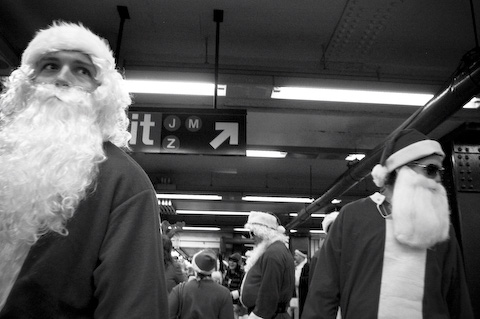
Happy holidays. Working on a few new things....
Above: an image from Santacon 2006.
Thursday, December 21, 2006
1,178,284 or so
Well, the original Project Redeye video is now the "18th Most Viewed (All Time) in Arts & Animation" on YouTube.
So, here's Project Redeye 2: "Holiday Photo Challenge" edition.
So, here's Project Redeye 2: "Holiday Photo Challenge" edition.
Tuesday, December 12, 2006
New School Faculty Overrun Sundance
I am impressed:
Five faculty members from the Department of Media Studies and Film will have their work shown at this year’s Sundance Film Festival in Park City, Utah, to be held in January 2007. Another faculty member Lewis Erskine will serve on the Documentary Jury. The five films and their directors/media faculty include:
Everything's Cool, directed by Judith Helfand and Daniel B. Gold, examines a group of self-appointed global warming messengers who are on a high-stakes quest to find the iconic image, proper language, and points of leverage to help the public go from embracing the urgency of the problem to creating the political will necessary to move to an alternative energy economy. World Premiere.
Ghosts of Abu Ghraib, directed by Rory Kennedy and edited by Media Studies/Documentary Studies faculty member Sari Gilman, looks at the abuses that occurred at the infamous Iraqi prison in the fall of 2003 by using direct personal narratives of perpetrators, witnesses, and victims to probe the effects of the abuses on all involved. World Premiere.
Hot House/Israel, directed by Shimon Dotan, provides an unprecedented look at how Israeli prisons have become the breeding ground for the next generation of Palestinian leaders as well as the birthplace of future terrorist threats. North American Premiere.
Freeheld, directed by Cynthia Wade, tells the story of Lieutenant Laurel Hester, who while dying of cancer, fights to leave her pension to her domestic partner, provoking an enormous battle in New Jersey. World Premiere.
Saturday, December 09, 2006
Mixed Messages, Mixed Drinks

Last night was the "Mixed Messages 2006" event.
12th and 3rd in Brooklyn showed on the big screen, and looked good. The audience laughed in the right places and applauded strongly. (If I were re-editing, I might reconsider the "false endings" or at least re-time them, but the point is that it played well with a large audience.) I thought the rest of the program was strong, too, and I was surprised that there were several documentaries screening. We did not have to resort to weeping. John Cameron Mitchell and the show's organizers gave out the awards.
We received "Special Recognition for Narrative Documentary" and an envelope containing various prizes.
Of course, I'm not a reliable reporter of the whole process: once they called our names, my brain sort of stopped working in its normal fashion (not because awards are a big deal, but because I have a tough time in front of any audience of any size) and I only have partial memories of going on stage, getting photographed, and the rest of the process. I have much clearer memories of going out after. The point, of course, is that Documentary is not about awards. It's clearly about Cucumber Martinis all around....
One Meeeeeeeeeeeelion and Two
The sequel to the "Project Redeye" video for youtube has been shot.
(Because the first one left so many unanswered questions. Like "Why did you post this, exactly?" and "Doesn't youtube.com watch these things before putting them on the front page?" and many, many others.)
Higher production values. Slightly improved lighting. Coming to a youtube screen near you....
(Because the first one left so many unanswered questions. Like "Why did you post this, exactly?" and "Doesn't youtube.com watch these things before putting them on the front page?" and many, many others.)
Higher production values. Slightly improved lighting. Coming to a youtube screen near you....
Subscribe to:
Posts (Atom)