Showing posts with label photoshop. Show all posts

Wednesday, October 14, 2009

Adobe Photoshop For iPhone


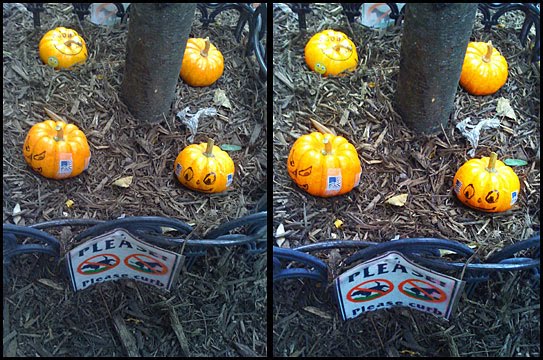
Above: I took a snap of a micro pumpkin patch on 89th Street this evening. It was a great opportunity to test out Adobe's Photoshop for iPhone.

Here's the process: I clicked on the Photoshop icon, and it asked if I wanted to take a photo or use an existing image. I chose the image, then used the crop tool to take out some unneeded detail, turned the saturation slider to plus 10, turned the exposure adjustment up a little, and chose to exit and save. That's it. The photo appeared in my phone's photo library and was ready to post. The original is at left.

It's a very simple app, it's free, and it does the basics. Not bad at all.

Sunday, April 13, 2008

Photography in the News

Any Photoshop-related items in today's U.K. news? Yes, and as always it is the photo retouchers who are to blame... or credit.

Now fashion mags make models 'fatter'
Another agency, the iWanex Studio, boasts a portfolio of "before and after" images of celebrities that it has retouched for magazines. In one of the "after" photographs, the thighs of Cameron Diaz, the actress, have been visibly widened, her arms filled out and her stomach made smoother and rounder, with her prominent hip bones from the "before" photograph erased.

Wednesday, April 09, 2008

Know Your Chinese 'Shoppers

Here's the scene: you're invited to a cocktail party, and as always all anyone wants to talk about is naughty Chinese photographers who win awards and are then stripped of those awards for having Photoshopped their pictures. You have a vague memory of this, you read something about it somewhere, but there are so many that you can't quite remember....

To help you avoid this disastrous social setback, I've prepared a short guide:
Photographer: Zhang Liang
Social Issue: bird flu
Animal Photoshopped: pigeons
Won: gold award, China International Press Photo Contest, 2005
Story: Watch the birdy
Statement: "I would like to apologise to the public."

Photographer: Liu Weiqiang
Social Issue: antelope protection
Animal Photoshopped: antelopes
Won: "10 most impressive news photos of 2006"
Story: Editor quits, paper apologizes
Statement: "I spent two weeks there waiting for the antelopes and train to appear together, but they never did."

Photographer: Zhou Zhenglong
Social Issue: existence of wild South China tigers
Animal Photoshopped: tiger (allegedly)
Won: 20,000 yuan (US$2,666)
Story: Photo of 'extinct' tiger sparks controversy
Statement: "Zhou Zhenglong risked his life in taking these photos, so they are very precious."

Photographer: Ye Weitang
Social Issue: fire is bad
Animal Photoshopped: pig
Won: golden award, China International Photographic Arts Exposition, 2007
Story: Award Winner Was Faked
Statement: "...with so many other altered photographs winning awards, it would be a disaster to rescind all those awards."

Monday, April 07, 2008

Fake Pigeon Photograph of the Day

Are there any stories about photography in the news? Yes, and they all use the word "sacked" in them.

Photographer sacked over fake picture
Zhang Liang from the Harbin Daily submitted the picture "Over 800 pigeons at a square take the bird flu vaccine" to the China International Press Photo Contest in 2005 and came away with a gold award. Some of Zhang's peers launched an investigation, and two flying pigeons in the picture were said to have been fabricated. The organizer of the contest announced yesterday that the picture is a fake.
Watch the birdy: Cameraman sacked for fake pigeon
Zhang Liang, a former photographer for the Harbin Daily newspaper, admitted that he added a pigeon to a photo, using Photoshop software, which showed pigeons receiving bird flu vaccine shots from medical workers. The photo won the top prize in the first China International Press Photo Contest, held by the Photojournalist Society of China in 2005.

Tuesday, March 04, 2008

Shrinkage! or Can I Retouch It Until I Need Glasses?

Are there any stories about photography in today's news? You might regret asking.

Only follow the link below if you have a European attitude about seeing a naked man -- not Michael Musto this time -- on a billboard promoting opera.

Actor complains over 'distorted' naked billboard
"An actor who appears naked on a poster for the Royal Opera House is considering legal action because he claims the image has been distorted to shrink a certain part of his anatomy."
Well, there you go. Someone had to approach the Photoshop artist and say
"Could you, umm, de-emphasize, uh.... We want you to, well... this area here."

"What, reduce his Rigoletto?"

"Yes. Is there a filter for that?"

"No, that's going to have to be done by hand."
I'm sure by the time Adobe releases Photoshop CS4, there will be a plug-in specifically for this. You'll be able to adjust the shrinkage using a temperature scale. Why the delay? They can't stop laughing long enough to figure out what to name it.

Monday, February 25, 2008

Photo, Shopped Around

Sure, if we were willing to sort out the facts for ourselves and think on our own, we wouldn't leave it to Drudge to tell us what to think of photographs. Or leave it to the serious journalists to tell us what to think of Drudge thinking about photographs.

Obama Photo Swaddled in Mystery of Its Intent
A silly photo of Barack Obama, dressed in some sort of traditional African garb, mysteriously made its way to the Drudge Report Web site yesterday. The photograph, which showed Obama wearing a turban and swaddled in white fabric, was taken in 2006, when the Illinois senator was on a tour of Africa.

But what did it mean? Was it a deliberately leaked smear image? Or an innocent snapshot of a guy humoring the locals by dressing up? The photograph, which might just as easily be seen as feminizing Obama as suggesting hidden Islamic sympathies, didn't yield many clues.

...

Our current relation to photography is, perhaps, similar to how people who've been burned romantically relate to new suitors. There's suspicion, a longer period of testing, a lot of vetting and a lot of asking your friends what they think of your new special someone. That doesn't mean you can't still be seduced by an image, but it makes every image have to work harder to seal the deal.
That is very well-written, and except for being untrue it is an excellent thought.

By "our relation to photography" does the writer mean that of the Washington Post's photo editors? I had assumed they believed every photo they published to be vetted and tested already and not merely in some trial period.

Or does he mean the public? The same public who believe any number of impossible things over breakfast, before they set the tabloid down on the subway seat? Again and again surveys show that surprisingly high percentages of the public believe things that have been proven to be untrue, usually because someone in power claimed them to be true, or because a media story said "there's a claim made, is it true?" without clearly presenting any fact check. Or because a television "news" show took the stance that all sides of an argument are equal -- no matter what the facts are.

Still, perhaps I worry too much.

Clinton on photo: 'Why is anybody concerned about this?"
"I know nothing about it," Clinton told ABC affiliate WFAA. "This is in the public domain. But let's just stop and ask yourself: 'Why are you -- why is anybody concerned about this?'"

Clinton said that she found questions about whether her campaign leaked the photo to be "really laughable."
Well, perhaps in the future there will be a way for technology to save us and reveal whether a photo is true, false, retouched, in context, miscaptioned, significant, upside down and backwards, a slam, a slur, an outright lie, laughable or merely a Rorschach Test.

Researchers Look to Spot Photo Hoaxes
The key, she said, is to use tools in combination. A criminal or hoaxer might be sophisticated enough to defeat one technique, but not all at once.

Fridrich's research takes advantage of the fact that all cameras have tiny flaws, so small they don't affect what the eye can see. For example, her software could analyze a set of photographs taken by the same camera and notice that a certain, defective pixel is always dark. Seeing that pixel light up would suggest an alteration.

Dartmouth College professor Hany Farid, meanwhile, has developed a set of software tools he collectively calls Q-IF. He sells the programs for up to $25,000 a year.

One tool looks for the use of clone stamp, a feature for duplicating or erasing objects in an image. Two cloned flowers would appear identical and lack expected blemishes.

Another exploits how cameras capture color images. Color is a mixture of red, green and blue. Rather than have sensors that detect all three for each pixel, they generally alternate in a specific pattern. That pattern gets disrupted with airbrushing.
Yep, that does cost a lot. But at least we won't have to think about it ourselves.
Monday, February 18, 2008

Photography in the News

Of course, if you are going to 'shop, you'll want to do it well enough to not get caught. Also, not when employed as a news photographer.

TOP NEWS PHOTOGRAPHER 'FAKED' PICTURE
"Photo enthusiasts used their detective skills to prove that an award-winning photographer had digitally doctored an image purportedly showing antelope roaming just metres from a fast-moving train.

Chinese photographer Liu Weiqiang confessed after an internet user spotted a 'red line', which on closer inspection, turned out to be a join between two separate images that had been stitched together."
Editor quits, paper apologizes over doctored photo
"Photographer Liu Weiqiang's fake shot that appears to show Tibetan antelopes crossing near a bridge on the Qinghai-Tibet railway as a train passes. Wang Zhongyi, chief editor of the newspaper, resigned on Sunday over the scandal, according to sources at the Daqing-based press.

The newspaper's apology came two days after staff photographer Liu Weiqiang, 41, admitted he faked the picture."
Photographer 'sorry' for faking Tibetan antelope picture, blacklisted by Chinese media
"The 41-year-old photographer allegedly pieced together two photos into one to show more than 20 Tibetan antelopes roaming peacefully under a bridge of the Qinghai-Tibet Railway.

The photo, named "Qinghai-Tibet Railway opening green passageway for wild animals", was among the "10 most impressive news photos of 2006", an annual event sponsored by state media China Central Television (CCTV)."
And I thought Photoshop meant never having to say you're sorry.

Shopped


I'm teaching a unit on retouching in Photoshop, so I've been giving my students "before" pictures. I decided I would try one myself, so I grabbed a celebrity mugshot, and started a timer.

Above: twenty minutes later. I think more could be done with the hair, but I ran out of time.